

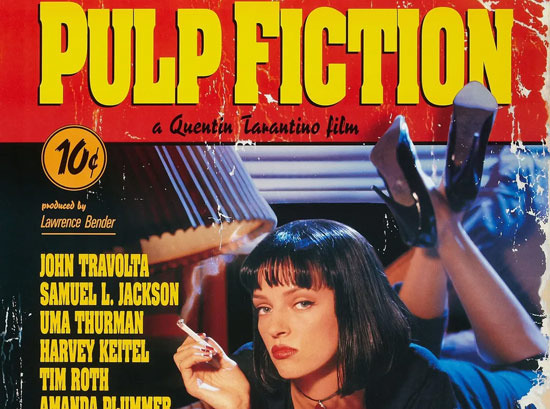
The year 1994 is not just another year in film history. There is a work that can be distinctly divided into "before this" and "after this."
That work is Pulp Fiction. This film is not just a well-made crime movie; it fundamentally changed the way films are made.
So, to exaggerate a bit, we can say there is a distinction between "movies before Pulp Fiction" and "movies after Pulp Fiction."
Pulp Fiction means 'cheap novels,' 'low-quality magazine stories,' or 'third-rate novels' in Korean. The term originates from the provocative and popular short story magazines printed on rough, low-quality pulp paper in the early 20th century, referring to unusual and gritty crime stories in the film.
Hollywood before Pulp Fiction was kind.
Films crafted by directors and staff had to flow in chronological order, character actions had to have reasons, and everything had to be resolved in some way by the end.
Explaining things clearly for the audience was a basic virtue. It was literally a way of "holding on to ensure nothing is missed."
But Tarantino just breaks this mold.
He does not tell the story in chronological order.
Beginnings and endings are mixed up, dead characters reappear, and different episodes suddenly connect.
Strangely, the audience follows along. In fact, they become more engaged.
This brings about an important change: it is not the director leading the audience, but the audience piecing together the puzzle themselves.
What changed most after this film is that "the audience began to be trusted."
Whereas before, everything had to be explained kindly, now the audience is allowed to figure things out on their own.
It becomes acceptable for the timeline to be mixed up, for the ending to be ambiguous, and for there to be no moral message.
In fact, these elements become part of the film's style. The moment when not explaining becomes an aesthetic.
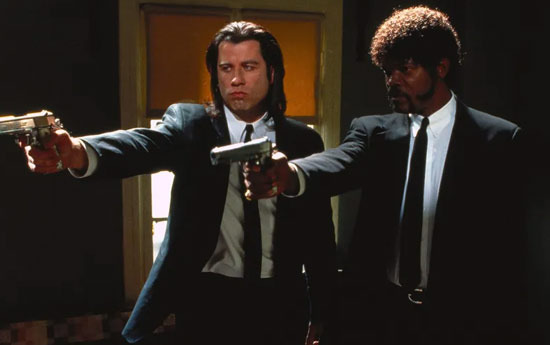
Another change is in the dialogue.
Previously, dialogue was a tool for conveying the story. But Quentin Tarantino turns dialogue itself into content.
Conversations about hamburgers, foot massages, and other trivial matters take center stage in the film.
It does not matter if they are not directly related to the plot. Those conversations create characters and set the mood. This was a quite radical approach for its time.
Violent expressions also change. Previously, violence was either a goal or a message, but here it becomes a style.
It is sudden, exaggerated, and sometimes even funny. It is uncomfortable yet strangely captivating.
At this point, the film shifts from being a moral textbook to a sensory experience.
The Los Angeles setting is also important. The Los Angeles in this film is not a tourist city.
It is a gritty, realistic space where criminals, boxers, drug dealers, and mob bosses' wives intermingle.
Yet, this space is presented in a very stylish way. Ordinary diners, roads, and apartments all transform into iconic locations.
The city itself feels like a character.
Many works have been influenced by this film since then. Non-linear structures, episodic developments, genre mixing.
These techniques are now common, but at the time, they were almost experimental attempts.
And the fact that this experiment was a commercial success is even more significant. The standard has changed to "it is okay to make it this way."
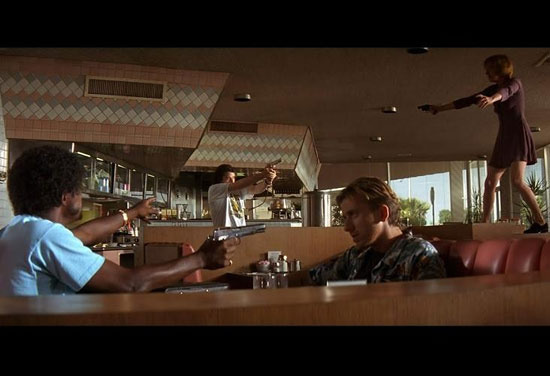
Of course, saying that all films changed because of this movie might be an exaggeration.
But at least one thing is clear: after this film, movies are no longer made in just one way.
The audience is no longer a passive entity but has become an active participant in interpretation and connection.
Ultimately, this film did not just leave behind a story; it changed the very way films are viewed.
That is why this work continues to be discussed even today.
Not just because it is entertaining, but because it has changed the way we see films that came after it.
Quentin Tarantino's Pulp Fiction achieved both critical acclaim and box office success.
In terms of box office, this film grossed over $213.9 million worldwide.
Considering the production cost, that is almost unbelievable.
Especially among the films that won the Palme d'Or at the Cannes Film Festival, there are not many that made this much money.
It is a case of an art film that also became a commercial hit.
The award records are impressive as well. It won the Palme d'Or at the 47th Cannes Film Festival in 1994 and won the Academy Award for Best Original Screenplay in 1995.
Additionally, it was nominated in a total of 7 categories, including Best Screenplay at the Golden Globes and Best Picture, Best Director, and Best Screenplay at the National Society of Film Critics Awards.
The ratings are also high. It has a Metacritic score of 94, a Rotten Tomatoes score of 92%, and an IMDb score of 8.9. It is rare for a film to maintain such scores even after so much time has passed.
In summary, this film is not just a box office hit; it is a benchmark work that continues to be referenced in film history.




 Tan Sol |
 Day by day |
 Kitchen Ideas |
 Iowa Egen Aunt |
 Beauty, Health, Lifestyle Blog |
 Weekend Movie Blog |
 coloradoman |
 Superman Cat Blog |
 Victory 1988 |
  United States National Administrative Organization Stories |
  springwaltz |
  dense |
  Tiger Milk Foam Research Institute |
  Oreore Mushroom |
  optimistic |
  Good Good |
  berion88 |
  bravo777 |
  skyblue |
  Project Tomorrow |
  apricotla |
  Soy Angelino |
  nati8 |
  NE Hodori Preik |
  washington mom |
  celtics |
  Balancework |
  round1 |
  Way to easy |