


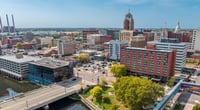
Lansing, the state capital and a long-time hub of the automotive industry, is undergoing significant changes due to the transition to electric vehicles in recent years. It is essential to examine how this shift is shaping the local economy through data. Given that Lansing has grown alongside the automotive industry for a long time, it is also important to consider the impact of this industrial transformation on the overall regional economy.
While Lansing's population has remained relatively stable or slightly decreased in recent years, the population in the surrounding metropolitan area, including East Lansing and Delta Township, has been gradually maintained. There is a clear trend of young people moving toward East Lansing, home to Michigan State University, and the demand for housing in suburban areas is relatively strong compared to the urban center.
The industrial base is centered around General Motors' Lansing Grand River plant and the battery production facility in Delta Township. Investments in Ultium Cells' battery plant are reported to have created thousands of jobs in the area, indicating a restructuring of the local employment landscape due to the electrification of the automotive industry. However, the operational rates of battery plants and the pace of new hiring may fluctuate based on the demand for electric vehicles.
The unemployment rate hovers around 4 percent, similar to the national average. While income growth is gradually rising in line with wage restructuring in the automotive industry, it is important to note that the high dependence on manufacturing can lead to significant fluctuations based on economic conditions. Public sector jobs provided by the state government serve as a relatively stable income base.
In terms of infrastructure investment, road and power grid expansions related to battery plants are being prioritized, and discussions about redeveloping the downtown area where the state government offices are located are also ongoing. However, there have not yet been notable cases of attracting large data centers or new logistics hubs. Development of commercial facilities near the Michigan State University campus is also progressing slowly.
Institutions like the Brookings Institution have evaluated that the transition to electrification could present new opportunities for the Rust Belt economy, while also frequently mentioning the demand volatility of the battery industry and the risks of policy changes. Lansing should also be observed from this dual perspective, and the possibility that changes in subsidy policies could affect the pace of investment cannot be ruled out. It is important to keep in mind that if the demand for electric vehicles grows more slowly than expected, there may be adjustments to related hiring plans.
For Korean households, relatively affordable housing prices and stable public sector jobs can be attractive factors. However, given the ongoing population stagnation, an approach focused on stable rental income rather than capital gains may be more realistic. The steady demand for rentals from students near university areas like East Lansing is also worth noting, as is the rental demand from state government employees and workers at the battery plant.
Recent market trends indicate that Lansing is a region facing the variable of the electric vehicle industry transition, and depending on how this trend stabilizes, the direction for the next 10 years could vary significantly. Careful observation and a long-term perspective are recommended.
 MeatballRunnr
 StarTaleSchl






 garlic bread |
 Sugar Cream Door Bulletproof Noodles |
 urbanmint |
 |
| 
 Premium Gas Camp |
 sugartrail |
 raspberry7 |
 toffee |

 bloom |
  draxen |
  gallery |
  milkyotter |
  Zoom Zoom Zoom |
  Minnesota Lakes and Clouds |
  noraro |
  tervox95 |
  vale vale |
  yentra |
  Golden life |
  andrew park |
  Peter Pan Pet |
  Balan |
  Cali M Law Group |
  neroyo |
  Dreams Come True as Desired |
  Khan Film Blog Production |
  coloradoman |
  Living Economy Information Blog |
  rustley |