

When I think of the moment I truly fell into Japanese animation, 1989 comes to mind.
There was one work that surprised me the most at that time, and that was "AKIRA."
It was the very next year after the Seoul Olympics, and the first time I saw AKIRA on a Japanese laserdisc that my friend had obtained was nothing short of shocking.
Until then, the animation I knew was cute and cheerful cartoons in the Disney style.
These were works that contained moral messages suitable for children and ended with happy endings. But AKIRA was different in every way. The atmosphere was dark, the urban background was filled with chaos and destruction, and the characters exuded a rough and intimidating energy.
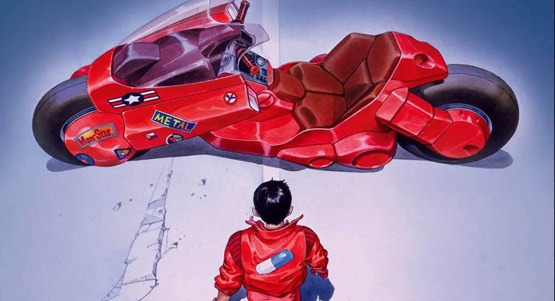
What I particularly remember vividly is the opening scene. A sequence of bikers racing through the night streets of Neo-Tokyo. Under the flashing neon signs, a red electric motorcycle speeds without restraint. Just that one scene made me feel something stir within me. It was beyond simply being cool; I was convinced that 'this is not the animation I knew.'
What was most astonishing was the depth of the worldview. Neo-Tokyo, rebuilt after a nuclear explosion, political corruption, government conspiracies, psychic experiments, and religious fanaticism... every plot was connected to reality. That night, after watching AKIRA for the first time, my mind was so cluttered that I couldn't sleep.
The only thought I had at that time was, "Is this really made by Japanese people?" I couldn't believe it. The very fact that animation could tackle such heavy and serious themes was shocking. From that moment, my 'exploration of Japanese culture' began. I started looking for works like Ghost in the Shell, Innocence, and Evangelion, but the starting point of it all was ultimately AKIRA.
As time passed, I learned that the shock of AKIRA was not just my own experience. The Wachowski sisters of The Matrix, Christopher Nolan, and Guillermo del Toro have all stated that they were influenced by AKIRA, and even Kanye West included an homage to AKIRA in his music video. The themes of collapsing cities, bike action, and the rampage of superpowers completely changed the Hollywood cyberpunk aesthetic.
Another interesting point is that in 80s and 90s American pop culture, Japan was often depicted as a 'technological powerhouse,' but AKIRA added a layer of dystopian anxiety and philosophical questions to that image. Japan began to be recognized not just as a country noted for economic growth, but as a creative nation that throws out the sensibilities and philosophies of future societies.
Personally, AKIRA had a significant impact on my sensibility in life. Before that, I had the stereotype that 'animation is for children,' but now I focus more on the messages and aesthetics contained within the medium rather than its form. Even in the digital age, the image of a future city in my mind is still realized as Neo-Tokyo.
As of 2025, AKIRA is not a work that has been fossilized as a classic, but is still a work in progress. Themes like dystopia, government control, and the ethical limits of science are directly connected to the reality we face every day. It was not just my shock, but the 'AKIRA shock' experienced by countless creators around the world.
Ultimately, AKIRA is not just a simple animation, but a work that questions civilization and the future of humanity. And that prophecy is still valid today.







 Victory 1988 |
 El Dorado |
 lightyear |
 Moscow Kim |
 coloradoman |
 Cali M Law Group |

 Olivia's Blog |
 Various Knowledge and Information in the USA |
 Whoever It Is, I Don't Know |
  yentra |
  Make My Day |
  Tonky |
  viroma |
  cookie |
  Live and that's it |
  Alright Twain |
  eatontown blog |
  HAWAII Korean Church News |
  Amore |
  linex |
  Balancework |
  laro90 |
  MEDBIO American Doctor Blog |
  SWAT TEAM BLK |
  DREAM BIG |
  frostbite |
  330 Forever My Love |