

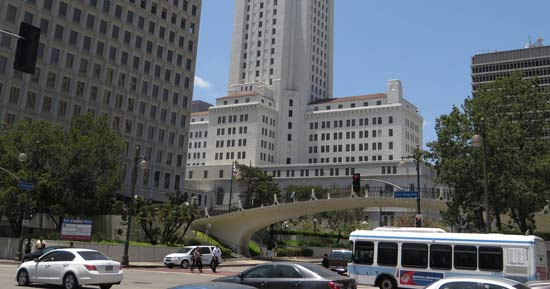
Walking around L.A. City Hall for the first time, you might feel it's quieter than expected. In the middle of a big city, why is it so relaxed? It's a natural thought. It's not like Long Beach or Koreatown, where shops line the streets, nor is it a tourist spot like Santa Monica, bustling with people. During rush hour, you see office workers in suits, but after lunch, it feels almost empty as if everyone has vanished. Why is that? The main reason is that this area is strictly an 'administrative center.'
With City Hall, courts, and various public institutions clustered together, it gets a bit lively during lunch, but by 4 or 5 PM when work ends, the flow of people drops sharply. It's not that there aren't many companies, but since it's not a hub for trendy IT or entertainment businesses, a culture of staying and spending after work hasn't developed well. Due to the nature of public institutions, while there are many employees inside the buildings, the spaces aren't frequented by citizens, making the perceived population density on the streets feel much lower.
Additionally, the chronic issues faced by downtown, such as safety and homelessness, cannot be ignored. The area right near City Hall is relatively well-maintained, but just a few blocks away, the atmosphere changes drastically, creating zones that raise caution. In the evenings or on weekends, the flow of office workers stops, naturally reducing the number of people, and the burden of commercial facilities coming in leads to a vicious cycle of vacancies.
As a result, restaurants and cafes often operate around lunchtime on weekdays, and it's common for places to close or have shorter hours on weekends. Ultimately, the lack of sustained consumer demand makes it difficult for vibrancy to develop. Moreover, the plaza in front of City Hall only gets crowded during events, far from the feeling of being bustling on a daily basis.
The pattern of only coming alive during specific events like film shoots, rallies, or City Hall functions repeats. In contrast, Santa Monica and Hollywood consistently attract tourists, while Koreatown has a high residential density, making it a neighborhood that stays lively even at night, highlighting the differences.
So, is there no way for the area around City Hall to regain its vibrancy in the future?
I believe there is plenty of potential. If some office spaces are repurposed for residential use and small cafes, bars, and galleries increase nearby, it could transform from a 'city that empties after work' to a 'city people want to stay in.' In fact, several development projects are underway, and small changes are already being noticed.
The key is to create a neighborhood where people feel comfortable staying, improve safety and accessibility, and give citizens a reason to want to visit. In other words, the current calmness might signal an economic downturn, but conversely, it also indicates that there is space left for the next change.
While it may not be as crowded as a tourist spot, there are likely people who enjoy the tranquility, with breathing space and a sense of the buildings and historical atmosphere.
If it finds its vibrancy again someday, the current stillness might be remembered as a prelude to change.





 Weekend Movie Blog |
 Beauty, Health, Lifestyle Blog |
 coloradoman |
 Superman Cat Blog |
 novapixel |
  US Embassy |
  Korean Mom |
  My NYC |
  moo moo |
  Mr Oh |
  forevergee |
  festival |
  manchester |
  constant |
  Leapfrog Move |
  vibranto |
  Tora Tora |
  yellowbutter |
  Dolly |
  NYC saladbar |
  Finding Superfoods |
  lightyear |
  song bang |
  vexomo |
  Indiana Jones |