
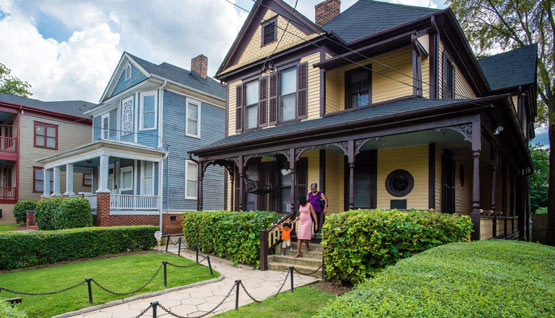
When talking about Atlanta, one cannot overlook the story of Martin Luther King Jr.
This city is not just where he was born, but also the space where his faith, thoughts, and the roots of the civil rights movement grew.
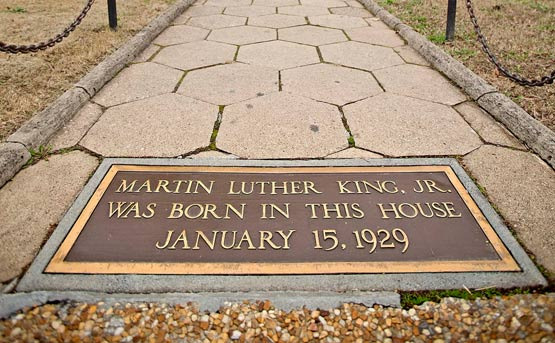
Dr. King was born on January 15, 1929, on Auburn Avenue, and today this area is preserved as the Martin Luther King Jr. National Historical Park.
The National Park Service describes this place as "a space to walk in his footsteps."
The key sites to visit here include Dr. King's childhood home, Ebenezer Baptist Church, The King Center, and the gravesite of Dr. King and Coretta Scott King. The home tour is operated by the National Park Service and is limited to a certain number of visitors on a first-come, first-served basis. It is advisable to check the operating status before visiting.
Ebenezer Baptist Church is one of the most important places to understand Dr. King.
This is not just a church; it was the stage where his language and leadership were formed.
Dr. King grew up as the son of a pastor and learned how to move people's hearts through the preacher's words. This is why his speeches resonate like prayers rather than mere political slogans.
As a figure, Dr. King was a blend of a cold strategist and a passionate preacher. He had the ability to transform anger into moral strength rather than using it solely for anger. He spoke of nonviolence against violence, but that did not mean passively enduring.
Rather, it was a strong way to expose the injustices of the opponent to the world. Thus, Dr. King's nonviolence was not a meek attitude but calculated courage.
Dr. King's intellectual background is also important. He entered Morehouse College at the age of 15 and studied sociology.
Morehouse was a space that nurtured Dr. King's self-awareness as an African American intellectual and his perspective on social issues.
According to the Stanford King Research Institute, he is recorded as having entered Morehouse at the age of 15.
Auburn Avenue is not just a place that holds Dr. King's personal history. This street was once the center of black business, churches, theaters, insurance companies, and media, to the extent that it was referred to as "the richest black street in the world."According to the Georgia Encyclopedia, Fortune magazine described Auburn Avenue this way in 1956.
So, as you walk through this area, you will see that the African American community in the United States was not merely a group that faced discrimination.
They earned money, established schools, and built communities centered around churches, even in limited circumstances. Dr. King emerged from that very soil. It was not just poverty and oppression, but also pride, education, faith, and community that shaped him.
This history is not just someone else's story for Korean Americans. Living as a minority in the United States sometimes means encountering walls that are hard to explain. Due to accents, skin color, names, and the background of being immigrants, they may experience subtle discrimination.
Therefore, Dr. King's message is not confined to black history. It is a very basic demand that humans should be treated with dignity.
If you visit Atlanta with children, Auburn Avenue is a street worth walking. The experience of seeing the house where he was born, the church where he preached, and the gravesite where he rests is much more lasting than reading about the civil rights movement in books.
Atlanta seems to be a living history classroom that shows how American democracy has gradually progressed through sacrifice and courage.
 CoffeeHunter








 Anova US Beauty Information |
 anchor |
 Korea Tiger News |
 Alpha and Omega World |
 Florida King |
 Let's Be Like a Salt-like City Person |
 Dingho and USA News |
 Maximum Pro |
 SPACE SHIP |
  USA Business News |
  Samsung My My |
  bubblo |
  tartbear |
  Washington Monument |
  Forever Young |
  crystalx |
  Spaghetti Flying Religion |
  lunarpath |
  Another Eden Channel BLOG |
  sprinkletop |
  bongo |
  savannah choi |
  Successful Manager Kim's Team |
  crystalo |
  Canvas Pro Blog |
  Time Management Enthusiast |
  Cap Com |
  nixxon |
  kevin Kim |