

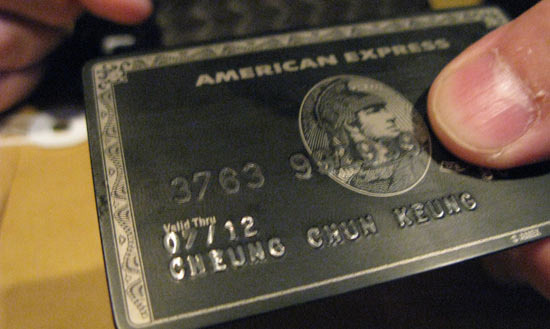
The American Express card limit is $12,000, but after spending about $11,000, a warning message appears saying, "Additional charges may not be allowed."
At first glance, you might think, "Why are they blocking me when I still have credit left?"
However, this isn't just about the remaining limit; it's due to the "risk signals" that the card issuer observes.
First, card issuers like American Express do not operate solely on the simple concept of limits that we think of.
The visible $12,000 is more of a 'guideline,' and internally, they perform much more complex calculations.
This is commonly referred to as a "soft limit." In other words, while the number is $12,000, depending on the situation, they may consider $9,000 as the safe zone, and in some months, they might allow up to $15,000.
So why does a warning appear at $11,000? The key factors are threefold.
The first is spending patterns.
If someone who usually spends $3,000 to $4,000 a month suddenly spends over $10,000, the card issuer immediately thinks, "This is unusual." Especially if the spending is concentrated over a short period, they react even more sensitively. The card issuer looks not just at the amount but also at the "speed" of spending. Spending $8,000 in three days is viewed as a completely different risk than spreading it out over a month.
The second factor is payment status.
If the previous bill hasn't been fully paid or only partially paid, the risk score increases. From the card issuer's perspective, this is interpreted as "trying to spend more while already in debt." American Express, in particular, views this very conservatively. Even if there is remaining credit, if they determine that additional spending is burdensome compared to the current balance, they will issue a warning immediately.
The third factor is external credit conditions.
This is something we may not be aware of, but card issuers update credit data in near real-time.
If usage on other cards suddenly increases or if the credit score fluctuates slightly, their internal algorithms react. For example, if high usage is already observed on another card, American Express will view additional spending as more risky.
The important point here is that this does not mean "we're blocking you right now" but rather "if you continue spending like this, the chances of being blocked are high."
In reality, a transaction attempt may be approved, but there could be a sudden rejection in the middle of the process. This can be particularly troublesome during important transactions.
So how should one respond? The most practical and safest method is to make intermediate payments.
If you've already spent $11,000, it's advisable to pay off some amount in advance. For instance, if you pay off $3,000 to $5,000 first, the card issuer will determine, "This person has repayment ability," and will grant more leeway.
The second approach is to diversify spending patterns. Spending large amounts all at once is less safe than spreading it out over several transactions.
Particularly, the habit of concentrating spending in a short period triggers these warnings the fastest.
The third is to utilize features like "Check Spending Power" in the card issuer's app.
American Express offers a feature that allows you to check in advance whether a certain amount will be approved before making a payment.
Using this can help avoid situations where payments are suddenly blocked.
Another interesting point is that these warnings could actually be a "good signal."
This is because it means the card issuer is informing you before completely blocking your usage.
It's much better than having a payment rejected without any warning.
The credit limit of $12,000 is not an absolute standard you can rely on.
The card issuer is always recalculating "the amount this person can handle in the current situation" in real-time.
In conclusion, this situation is not just a card issue but a matter of "spending patterns + risk management."
If you keep swiping without thought, you will repeatedly encounter blocks even within your limit.
The difference between those who understand this structure and those who do not ultimately leads to differences in card utilization skills.
Be cautious to avoid situations where you trust your card limit and set a budget, only to find that the card limit does not work out as expected.






 Silent Sea |
 Pointy |
 Idaho's Sumi's House |
 holy cheese |
 Michigan Enthusiast |
 There Are Such Things in the World |
 Sunny's Travel in America |
 Study Abroad Life Know-How Tips |

 novapixel |
  Healthy Local Fresh Information |
  molten |
  Way to easy |
  intact |
  Always Dreaming of Big Success |
  happy 9 |
  Park M.Y. |
  tredon |
  Poppin News |
  metsoo |
  dewyo |
  Casa Mia |
  Asparagus Blog |
  dorange |
  hiddenkong |
  some fame |
  Godory Life |
  Lime Juice |
  French fries |
  Rynex |