

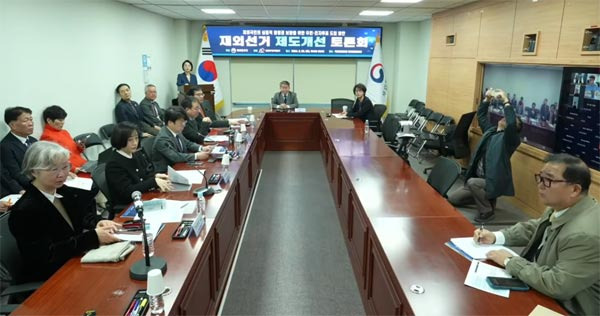
Last week, a discussion was held at the first meeting room of the National Assembly in South Korea.
They pondered why the voter turnout for overseas citizens is below 10%, and honestly, it's surprising that they are only now considering this issue.
There are 7.3 million overseas Koreans, and among them, about 1.97 million have the right to vote, yet the turnout is below 10%.
During the last presidential election, it was only 10.4%.
At this point, it seems more appropriate to ask, "Is the system even capable of facilitating this?" rather than just wondering, "Why isn't it happening?"
The reason is quite simple. It's incredibly inconvenient to go vote.
Currently, there are 223 polling places in 118 countries centered around overseas diplomatic missions, but is that reasonable?
The idea that this can cover the entire world seems a bit unrealistic.
Just looking at the United States, given the size of the land, it means driving for hours to vote. And that too on a weekday, haha.
You have to take time off work to do this. It seems a bit off to create a system like this and then ask, "Why aren't you voting?"
During the discussion, there was a lot of talk about mail-in voting and electronic voting.
OECD countries are already doing it, and there are examples from the U.S., France, and Germany.
Even Estonia conducts electronic voting regularly.
However, South Korea is still "under review." It's ironic that a country known for its IT prowess can't manage to conduct voting online.
Of course, there are reasons. Security issues, fairness concerns, and various other discussions come up.
But the fact that they have been unable to implement this for over ten years for the same reasons suggests a lack of will.
In today's world, electronic documents, electronic signatures, and even transfers of hundreds of thousands of dollars can be done online.
It feels like South Korea can do it but chooses not to. Meanwhile, overseas Koreans with voting rights are facing the same inconveniences.
Reports from the field indicate that to vote, you need to register in advance, go again on the day of voting, and spend more than two days on the process.
This is the reality. So, achieving even a 10% turnout is quite remarkable.
Honestly, it's not a situation where we can criticize the low participation rate; we should first examine how that 10% was achieved.
Another interesting point is that there are already several related bills in the National Assembly, yet they are not being properly discussed.
It seems they are not considered important issues. Meanwhile, they are also fervently stating, "We must guarantee the right to vote."
That statement is correct. However, the lack of corresponding action is the problem.
From the perspective of overseas citizens, there is a bittersweet aspect. They pay taxes, maintain their Korean nationality, and have interest, but when it comes time to vote, the barriers are too high.
Pointing out the low voter turnout while leaving the situation unchanged for years seems to be a reversal of priorities.
Ultimately, under the current system, voter turnout will never increase.
It is physically close to impossible. Whether it's mail-in voting, electronic voting, or at least significantly reducing the registration process, something needs to change. If nothing changes, we will continue to hover around the 10% mark.
Whenever such discussions arise, there is always a comment about needing to be "cautious."
However, if caution drags on too long, it simply becomes procrastination. From the perspective of overseas citizens, it feels like they have already waited long enough.
Personally, I believe the direction of this discussion is correct. But if it ends up being just another "good talk," it will be meaningless.
There needs to be actual change.
If not, the next election will again see headlines like "Voter turnout among overseas citizens below 10%... Are there any improvements?"
 USAToday






 lavender |
 logger |
 Conflite Teacher |
 Unknown Dog Walk blog |
 Khan Film Blog Production |
 Victory 1988 |
 Investment Campus Home Ownership |
 California Dreamer |
 Lightning Sikhye Cooking Method |
 Mr. Largo |
  breezem |
  Omelet Rice for Strength |
  Vermont Capt |
  Softy |
  solid90 |
  waltz |
  Ohio Ohayoung Hello |
  parlon |
  Shoot Me |
  Michigan Enthusiast |
  festive |
  You Turn Me On |
  Supplemental Security Income (SSI) Information |
  Sams Market |
  ansdal |
  VVV 80 |
  BIODOCTOR NEWS |
  Gold Bar |
  Tamfa Fan |