

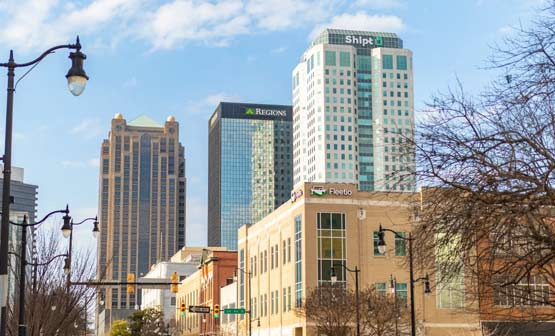
Birmingham was once known as the 'Steel City of the South,' with steel and manufacturing at its core.
Today, the industrial landscape has changed significantly, with healthcare, education, logistics, finance, and public services driving the local economy. In particular, the University of Alabama at Birmingham (UAB) and UAB Hospital are the largest employers in the area, employing thousands in healthcare and research.
However, the reason the median income is lower than the national average is that there are not many high-income IT or large financial corporate headquarters, and jobs in healthcare support, retail, food service, logistics, and manufacturing, which typically pay lower wages, make up a large portion of total employment.
Additionally, the relatively low cost of living and housing prices tend to keep wage levels lower than in major cities. However, for those who work remotely or hold professional positions with high salaries, the lower cost of living can significantly increase their real purchasing power.
According to the Census ACS 2023 estimates, the median household income in Birmingham is about $45,000. This is approximately 43% lower than the national median of $78,538.
This figure may seem quite low for Alabama's largest city.
The median home price in Birmingham is estimated to be around $170,000 to $220,000 according to Zillow. Compared to the national median home price, which exceeds $400,000, this is about half.
When looking at the price-to-income ratio, it is around 4 times, indicating a relatively accessible housing market.
Grocery and service prices are also lower than the national average. Alabama's cost of living index is reported to be around 85 to 90, based on a national average of 100. This means that while the nominal income is $45,000, the real purchasing power could be equivalent to $55,000 to $60,000 in higher-cost cities.
Digital property data shows that there are significant regional disparities within Birmingham. Suburban areas like Mountain Brook and Bessemer are classified as high-income communities with household incomes exceeding $100,000. In contrast, some urban areas have high poverty rates, pulling down the overall city average. The median income of $45,000 reflects an average of these extremes.
It is also important to consider the manufacturing sector. Birmingham has a history in the steel industry, and there are still metal processing and automotive parts manufacturing facilities distributed throughout the metro area. Skilled positions in this field often offer incomes in the range of $50,000 to $70,000, which helps support the median figure.
While Birmingham may appear to have low incomes, the lower cost structure means that the city needs to be reevaluated in terms of real disposable income and housing accessibility. Rather than judging solely by the figure that is half the national average income, a more accurate picture emerges when considering the actual cost of living.
 HanselSaid
 MaxPromo







 |
| 
 Premium Gas Camp |
 CA Real Estate |
 cheesepup |
 breezem |
 Information on All Regions of the United States |
 SteelOrbit |
 Alabama Bang |

 Sammy Beach |
  Bliss O |
  blue ocean |
  greenlight |
  Watanaka Karametibaksa |
  castle |
  xelton52 |
  carefree |
  vrixen73 |
  AZ Road Master |
  Victory 1988 |
  summita |
  business lim |
  Colorado Lee |
  Make My Day |
  Fros Pro |
  lioness |
  La Bean |
  American History This and That |
  Monte Sori |