
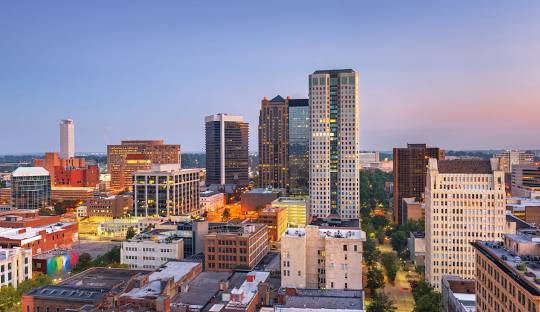
Birmingham, Alabama, is the second largest city in the state of Alabama and is a region of historical, economic, and cultural significance. Located in the central part of the state, it is particularly known as a center of the industrial revolution and the civil rights movement.
Establishment and Early History
Birmingham was established in 1871. At that time, Birmingham was born with the aim of becoming a center for the steel industry and the industrial revolution, utilizing resources such as iron, coal, and limestone along the Alabama River.
The reason for its name, derived from Birmingham, England, was a result of the influence of the British industrial revolution. By the late 19th century, due to the rapid growth of the steel industry, Birmingham had established itself as an important industrial city, earning the nickname "The Pittsburgh of the South."
Center of Industrialization
Steel and Industrial Development: In the early 20th century, Birmingham thrived in various industrial sectors such as steel, chemicals, and machinery manufacturing, emerging as a significant industrial center in the southern United States. During this period, large steel mills and coal mining industries were actively operated, making Birmingham a symbolic city of industrialization.
Rapid Urban Growth: Birmingham experienced economic prosperity through steel production, leading to a rapid increase in population. In particular, many immigrants flowed into the area, forming a multicultural society.
Center of the Civil Rights Movement
Birmingham was an important center of the civil rights movement in the 1960s. During this time, Birmingham became the site of protests and struggles against racial discrimination and inequality, creating a significant turning point in American history.
Violence and Conflict in Birmingham: Birmingham was one of the cities where racial discrimination was most severe in the South, and as a result, the civil rights movement erupted fiercely. Events such as the Birmingham riots (1963) shocked American society, and ultimately, key figures like Martin Luther King led the struggle for civil rights through nonviolent resistance.
1963, "Birmingham Church Bombing": Birmingham is also known for the 16th Street Baptist Church bombing in 1963. This tragic event resulted in the deaths of four African American girls due to a bombing at the church. This incident sparked the civil rights movement, and Birmingham remains an important symbolic location for civil rights in the United States.
Late 20th Century and Redevelopment
Birmingham faced economic difficulties due to the decline of industrialization and the downturn of the coal and steel industries. However, in the 1980s and 1990s, urban redevelopment and cultural changes took place.
Healthcare Industry and Research: Birmingham rapidly developed in the healthcare and life sciences sectors, with the University of Alabama at Birmingham (UAB) growing into one of the major medical research facilities in the southern United States. As a result, the healthcare industry became a key economic sector in the city.
Culture and Education: Birmingham also developed culturally, with active art galleries, museums, and performing arts. Additionally, significant advancements were made in the field of education, with the University of Alabama Birmingham campus functioning as a center for research and education.







 Magic Cabbage School of Martial Arts |
 Vacation on Hawaii |
 morvex37 |
 Ari Songhan American Immigration Life |
 Bearded Strawberry Smoothie |
 Information on All Regions of the United States |
 Alabama Nice Papa |
 Star Voyager |
 toastyfox |
 Certified Authentication Blog Page |
  Tonky |
  viroma |
  cookie |
  Live and that's it |
  Alright Twain |
  eatontown blog |
  HAWAII Korean Church News |
  Amore |
  linex |
  Balancework |
  laro90 |
  MEDBIO American Doctor Blog |
  SWAT TEAM BLK |
  DREAM BIG |
  frostbite |
  330 Forever My Love |
  El Dorado |
  dralix58 |
  Gorama Round |
  Skydiving |