

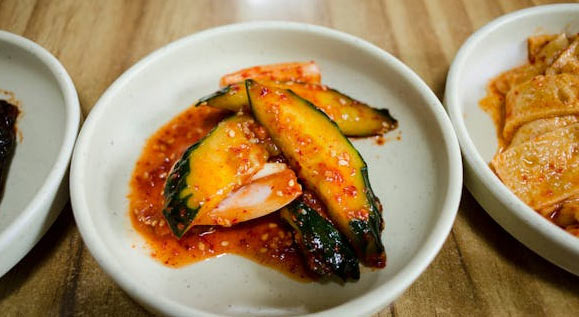
Side dishes are an essential part of the Korean dining table. Nowadays, many Americans enjoy Korean food and are familiar with the side dish culture, but 30 years ago, the concept of free refills of side dishes was a novel idea.
Side dishes (飯饌) refer to foods that complement the nutrients not fulfilled by the staple rice or are eaten to enhance flavor and satiety. While they may be seen as mere side dishes, they actually embody the lifestyle, seasonal awareness, and emotions of Koreans.
Kimchi, without a doubt, is a staple that appears in almost every meal, so in Korea, it is common not to count kimchi when tallying the number of side dishes. In other words, kimchi is a given, and the question is how many additional dishes there are.
Koreans typically enjoy an average of 3 to 6 side dishes with their daily meals. In a typical home-cooked meal, there are usually around 35 side dishes along with one soup. One type of kimchi is standard, and the remaining 24 dishes are filled with various items like namul, stir-fries, stews, and salads.
When dining alone, it is common to finish with just 12 side dishes and one bowl of soup. In restaurants, many places offer around 58 side dishes, such as in a lunch box restaurant or a Korean buffet. From a guest's perspective, the more side dishes there are, the more effort is perceived to have gone into the meal, making side dishes an important aspect of the dining experience. In traditional Korean meals, it is not uncommon to see 10 to over 20 side dishes served at once.
Similar to Korea, Japan also has a home-cooked culture centered around rice (米ごはん). In Japan, side dishes are called おかず, and while the basic concept is similar, the number of side dishes is generally fewer compared to Korea. Particularly in Japanese dining culture, side dishes are not essential, and there is rarely a structure for refills. In contrast, in Korea, side dishes are usually included in the total price when dining out, and refills are often allowed. Even in Korean restaurants in Japan, refills for side dishes often incur additional costs. Perhaps because of this, outside of Korea, dishes like sushi and ramen, which are complete meals in one bowl, have become the representative image of Japanese cuisine.
The concept of side dishes has very old historical roots. Ancient records and murals from before the Three Kingdoms period show traces of meals centered around grains accompanied by ingredients like vegetables or meat. This indicates that 'side dishes' have been an important element of the dining table for a long time.
By the Joseon Dynasty, the structure of side dishes became systematized by class within the Confucian order. This is what is commonly referred to as the 3, 5, 7, 9, or 12 side dish meals. In commoner households, a 3-side dish meal was typical, while 5 or 7 side dishes were common in noble families, and 9 or 12 side dishes were seen only in royal or upper-class settings. Thus, the number of side dishes served was not just about the variety of food but also a means of displaying status and prestige.
During this period, preserved side dishes also developed, as the seasonal availability of ingredients made storage and preservation very important. Therefore, side dishes with high preservation qualities, such as kimchi, pickled vegetables, and salted seafood, developed, leading to the culture that continues to this day with kimchi refrigerators.
After the Japanese occupation, Japanese cuisine and Western cooking methods began to seep into Korean food culture. During this time, dishes like tonkatsu, inari sushi, soup, and curry naturally found their way into Korean households, and after liberation, with the influx of American culture, Western-style side dishes like spam, ham, mayonnaise salad, and pickles also emerged. Since the 1980s, rapid industrialization and urbanization have led to changes in side dishes, making them easier and quicker to prepare. Many side dishes became readily available for purchase at supermarkets, and the lunchbox culture became popular, turning side dishes into mass-produced items.
Today, side dishes have transcended their historical symbolism of status and have become a means of expressing individual preferences, health, and identity. There are dozens of types of kimchi alone, and nowadays, options like vegan side dishes, low-sodium side dishes, and gluten-free side dishes have expanded. As Korean cuisine globalizes, fusion side dishes tailored to foreign tastes are also increasing.
Ultimately, side dishes are not just mere accompaniments to rice but can be seen as vessels that encapsulate the lives, philosophies, and emotions of Koreans. They embody the seasonal essence of nature, express familial bonds, and consider the health and tastes of those who eat them, all of which are deeply ingrained in the culture of side dishes.
Perhaps that is why Korean tables are always adorned with small yet diverse side dishes.






 novapixel |
 Peter Pan Pet |
 horse |
 Sunset Oregon |
 daisypat |
 Helpful Life Stories |
 Hajiwon Blog Hair Salon |
 American Man in a Mask |
 Texas Migration Story |
 Make My Day |
  vibranto |
  Tora Tora |
  yellowbutter |
  Dolly |
  US Embassy |
  NYC saladbar |
  Finding Superfoods |
  lightyear |
  song bang |
  vexomo |
  Indiana Jones |
  meloncat |
  mortrix |
  Esther 1983 |
  fortbliss |
  Moscow Kim |
  My Two Way |
  toastyfox |
  FLORIDA Acus |