
Southern Texas, especially the San Antonio and Hill Country areas, is heavily influenced by a subtropical climate.
Winters are short and mild, while summers are long and hot. These climate conditions create an environment where various plants and insects can thrive year-round, making it the first gateway for newcomers to encounter local allergies that they may not have experienced in Korea.
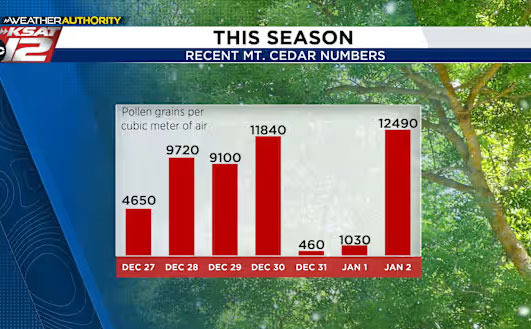
The most notorious local allergy in San Antonio is undoubtedly the pollen from Mountain Cedar. From late December to February each year, Ashe Juniper trees, which are native to the Hill Country, release an enormous amount of pollen all at once. During this time, the entire city appears to be shrouded in a yellow haze, a phenomenon known as 'Cedar Fever.' Although it has the name of a fever, it is actually an allergic reaction.
It's not just a simple runny nose or sneezing; it can severely irritate the eyes, nose, and throat, and may even be accompanied by headaches and fever symptoms, leading first-time sufferers to mistakenly think they have the flu and seek medical attention. This is a common shock for Korean immigrants experiencing their first winter in Texas. Those who expected, "It will be nice to have a warm winter," may find their perspective changed after spending a week in bed due to Cedar Fever starting in mid-January.
It's too early to relax just because winter is over. In spring, oak tree pollen takes over. From March to May, oak pollen can accumulate on cars in thick yellow layers. Even those who were fine during the cedar season may suddenly experience allergy symptoms during the oak season. One must overcome two significant mountains, cedar and oak, before truly welcoming the summer in Texas.
As outdoor activities increase in the summer, another menace appears: chiggers. These tiny mites are so small that they are often not visible to the naked eye, but after enjoying camping or hiking in grassy areas, intense itching around the legs, waist, and ankles begins a few days later. The itching is several times worse than a mosquito bite and can last more than a week, making it unforgettable once experienced.
Fortunately, prevention is not difficult. When entering areas with thick grass, wearing long pants and tucking socks over them, along with applying insect repellent containing DEET generously on the legs, is essential.
Texas's nature is undoubtedly attractive, but entering without prior knowledge of the small creatures that coexist within it and local allergies can make the first year quite challenging.
If you prepare in advance, you can adapt well, so if you have allergy medication to bring when moving, be sure to pack it.
 LunaMoonTV
 NYStoryMaker







 Smile Face |
 Helpful Life Stories |
 Casa Mia |
 Study Abroad Life Know-How Tips |
 pravix22 |
 TEXAS Fishing Boat |
 solvix18 |

 Texas Migration Story |
  explorer |
  dictionary |
  Mr Bull Jung |
  radiant |
  Georgia 88 |
  Great TOWN NEWS |
  Open Flex Mind |
  Hartford Blog |
  unified |
  Generation X |
  ringwinds |
  American Food Information & Calories |
  Hawaii Maui Kahului |
  calvorn |
  fernando park |
  newyorker 101 |
  coffeee |
  |
|  Christopher |
  sylven |