

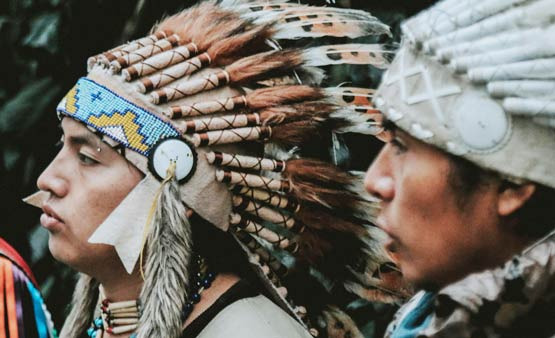
Why is the term "Indian" confusing?
In 1492, when Christopher Columbus arrived in the Americas, he mistakenly thought he was in India. Thus, he referred to the indigenous people living there as "Indians."
This was obviously a complete misunderstanding, but Europeans and later American settlers continued to use the term. Today, in the U.S., Native Americans are often referred to as "American Indians" or "Native Americans."
As time passed and contact with actual Indians increased, the term "Indian" became a term that refers to both groups.
-
One group is the people of India (India, South Asians)
-
The other group is Native Americans
To avoid confusion, the term "Native American" has increasingly been used in the U.S., while "Indian" has gradually shifted to refer to Indians. This trend became particularly pronounced from the late 20th century.
In the 1990s, as political correctness became emphasized in American society, the term "Indian" began to feel inappropriate or colonial to many Native Americans.
As a result, official documents and media began to use terms like "Native American" and "Indigenous Peoples", while "Indian" started to be firmly associated with people from India.
Changes Reflected in Google Search Results
Now, when searching for "Indian" in the U.S., most images and information pertain to Indians (South Asians), while searching for "인디언" in Korean still strongly reflects the image of historical Native Americans. This is due to the difference in the pace of language and cultural change. Korea still habitually uses the term '인디언' derived from Columbus's misunderstanding, which is reflected in Google's Korean search results.
In summary
-
"Indian" originally started from Columbus's misunderstanding
-
In the U.S., there is a trend to change to Native American to avoid confusion
-
Since the 1990s, "Indian" has become firmly associated with Indians
-
Korea still has a cultural inertia that perceives '인디언' as Native Americans






 Moscow Kim |
 coloradoman |
 Montgomery Mom |
 GOGO SING |
 Hajiwon Blog Hair Salon |
 Shining Our Own World |

 California Kangaroo |

 Reggae Party |
  Korean Mom |
  My NYC |
  moo moo |
  Mr Oh |
  forevergee |
  festival |
  manchester |
  constant |
  Leapfrog Move |
  vibranto |
  Tora Tora |
  yellowbutter |
  Dolly |
  US Embassy |
  NYC saladbar |
  Finding Superfoods |
  lightyear |
  song bang |
  vexomo |
  Indiana Jones |