

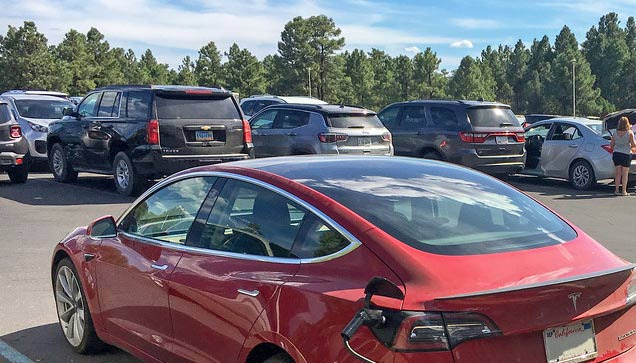
Two years ago, I made a big decision and bought a used Tesla Model 3 at a low price.
After driving it for about two years, I've definitely noticed that it's cheaper to drive than a gas car, but if you're not careful, it can actually end up being more expensive.
Let's start with charging. The most important thing is "where and when you charge."
Installing a charger at home and charging during off-peak hours is key.
In California, even though electricity rates are generally high, they drop significantly between 11 PM and 7 AM.
Charging during this time feels like it costs less than $2 per gallon.
I intentionally set a timer to charge while I sleep. Just doing this reduces my monthly maintenance costs significantly.
On the other hand, charging during the day can lead to high electricity bills that can be quite shocking.
You might wonder, "Is it really worth it to charge an electric car at home?" when you see the bill.
Many people make the mistake of only using public charging stations.
While places like Tesla Superchargers or Electrify America are convenient, the prices can be an issue.
It's common for rates to exceed $0.40 per kWh, and if you charge at the wrong time, it can go even higher.
I used to use them frequently without realizing the costs until I saw my credit card statement.
External charging should only be used "in case of true emergencies."
Ultimately, charging at home, at night, and slowly is the way to go. If you stick to these three rules, your maintenance costs will definitely go down.
Conversely, if you charge during the day and rely on fast charging, the benefits of owning an electric car almost disappear.
Many people are curious about "why does the driving range drop so much when you speed on the freeway?" I was surprised at first too. It's fine in the city, but when you drive at 75-80 mph on the freeway, the battery drains alarmingly fast.
The reason is that as speed increases, air resistance grows exponentially.
Electric cars use energy directly from the battery, so they have to use more energy to overcome this air resistance.
In simple terms, when you increase your speed from 60 to 80 mph, you're not just using 20 more; you're using a lot more energy.
Unlike gasoline cars, which become more efficient at high speeds, electric cars behave the opposite way.
Especially during rapid acceleration or maintaining high speeds, battery consumption increases significantly.
So, I intentionally keep my speed around 65-70 mph on the freeway.
Interestingly, electric cars are much more advantageous in city driving. When you stop at signals, regenerative braking recovers energy. So, in congested urban areas, the efficiency is actually better. Conversely, if you keep speeding on an empty freeway, you're at a disadvantage.
In the end, owning an electric car is mostly about "driving habits + charging habits."
Currently, my monthly maintenance costs are nearly half of what they were when I drove a gas car.
However, that's based on home charging and driving at lower speeds.
If you use Superchargers daily and speed on the freeway, you might find yourself thinking, "Why did I buy an electric car?"
 NoodleDefense







 kuku 100 |
 novent |
 Silent Sea |
 Pointy |
 Idaho's Sumi's House |
 Learn English Accurately |
 Neither Aunt nor Young Lady |
 Sandiego Auntie |
 Tainami American Travel Story |
 savannah choi |
  Successful Manager Kim's Team |
  crystalo |
  Canvas Pro Blog |
  Time Management Enthusiast |
  Cap Com |
  nixxon |
  kevin Kim |
  beerdreamer |
  Kims Spring |
  White bunny |
  Kansas City Representative Singer |
  shadow 007 |
  sun walker |
  Choco Choco Star |
  midnight blue |
  honeypot |
  summer |
  adventure77 |
  flexible |