

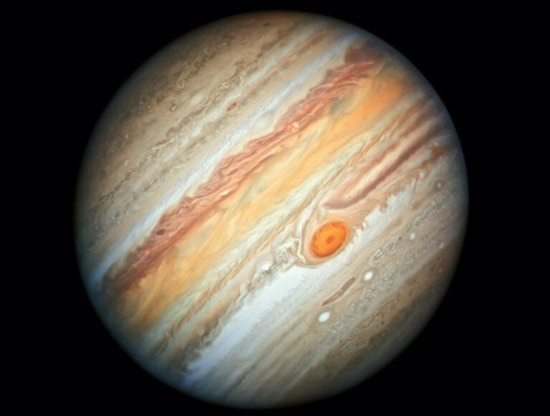
Yesterday, a news report came out stating that Jupiter is smaller and flatter than we previously thought.
It seems like Jupiter has gone on a diet, but this is no joke; it's serious enough to warrant changes in textbooks.
The size and shape of Jupiter that we have known were based on data from the Voyager and Pioneer spacecraft that flew by in the 1970s.
At that time, it was cutting-edge, and those figures have been used as the standard for nearly 50 years.
However, recent data from the Juno spacecraft has challenged those long-standing standards.
The method is quite interesting. It tracked how radio waves sent from Juno to Earth bend as they pass through Jupiter's atmosphere.
By calculating how the waves bend slightly and ultimately disappear behind the planet, they captured the true outline of Jupiter.
The result shows that Jupiter's radius from the poles to the center is about 12 kilometers smaller than we thought, and the equatorial radius is also about 4 kilometers smaller.
Looking at just the numbers, one might think, "What's the big deal?" Compared to Jupiter's size, that's a trivial difference.
But scientists say that this few-kilometer difference makes the internal structure model of Jupiter much more coherent.
So why are they so fixated on such a tiny difference?
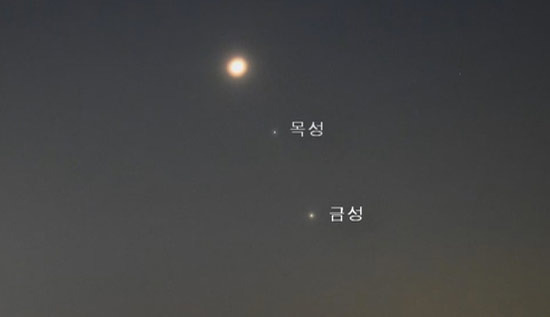
The reason is simple. Jupiter is likely the first planet formed in the solar system, serving as a kind of blueprint.
Understanding what Jupiter's interior looks like is crucial for understanding other gas giants and even exoplanets outside our solar system.
Interestingly, this result also reaffirms that "Jupiter is not a perfect sphere."
Due to its rapid rotation and constantly flowing atmosphere, its shape is subtly distorted by winds.
So, Jupiter is not a stationary mass but rather a living system where winds and gravity push and pull simultaneously.
Scientists plan to continue gathering more data from Juno.
The measurement accuracy has already improved to within hundreds of meters.
We are now in an era where we scrutinize the size of a single planet down to the smallest detail.
In that sense, science is always like that. The moment we think we know everything, we measure again.
Jupiter has gotten smaller, but human curiosity shows no signs of diminishing.






 Moscow Kim |
 coloradoman |
 Montgomery Mom |
 GOGO SING |
 Hajiwon Blog Hair Salon |
 Weekend Movie Blog |
 Beauty, Health, Lifestyle Blog |
 Superman Cat Blog |
 novapixel |
  Korean Mom |
  My NYC |
  moo moo |
  Mr Oh |
  forevergee |
  festival |
  manchester |
  constant |
  Leapfrog Move |
  vibranto |
  Tora Tora |
  yellowbutter |
  Dolly |
  US Embassy |
  NYC saladbar |
  Finding Superfoods |
  lightyear |
  song bang |
  vexomo |
  Indiana Jones |