

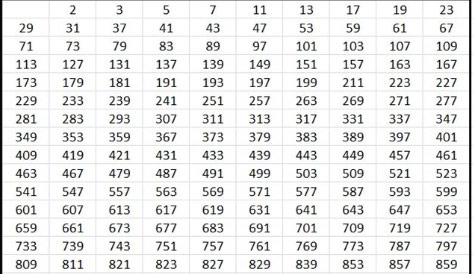
When we think of prime numbers, we often just think of numbers like 2, 3, 5, and 7 that cannot be divided evenly.
However, looking at primes from a different angle reveals an interesting rule.
Specifically, if a number is not divisible by 2 or 5, it will not terminate when divided by that number.
This is important because our number system itself holds the clues. We use the decimal system, and 10 is made up of 2 and 5. Therefore, if the denominator contains only 2 and 5, it can be divided exactly into powers of 10, and the decimal will eventually terminate.
For example, 1/2 is 0.5, 1/4 is 0.25, 1/5 is 0.2, and 1/20 is 0.05, all of which are neat. If you look closely at the denominators, they only contain 2 and 5. However, the moment a number like 3 or 7 enters the picture, things change. No matter how much you multiply 10, you cannot divide it exactly by 3 or 7, so the decimal cannot terminate. Thus, 1/3 is 0.333..., and 1/7 is 0.142857..., repeating endlessly.
At this point, the mystery of primes is revealed. All primes except for 2 and 5 cannot create finite decimals in the decimal system.
In other words, they are numbers that structurally conflict with the number system. Therefore, primes can be seen not just as numbers that cannot be divided, but as numbers that do not compromise with the standards we use.
In particular, 2 and 5 are very exceptional primes. 2 is the start of even numbers, and 5 holds a special position as half of 10.
Only these two are directly connected to the standard of 10. The remaining primes, no matter how large, do not fit neatly within this system. Thus, dividing 11 by 3 results in an infinite decimal, and dividing 11 by 7 also results in an infinite decimal.
This is not because 11 is special, but because the denominator is not 2 or 5. Interestingly, this rule is not something humans created.
It only appears that way because we chose the decimal system; if a civilization used base 12 or base 60, entirely different primes would have become 'neat numbers.' Ultimately, the mystery of prime numbers arises from the framework through which we view numbers.
However, within that framework, primes always remain uncomfortable entities. They do not fit neatly, do not terminate, repeat, and complicate calculations.
Nevertheless, all numbers are made up of the product of these primes. The fact that all numbers in the world are ultimately built on primes means that primes are uncomfortable but essential building blocks.
Thus, I believe that prime numbers are not just simple math problems, but entities that make us reflect on how we understand the world through numbers.
Primes are not only difficult for humans but also a formidable challenge for computers.
When numbers are small, it is easy to determine whether they are prime or not, but when the number of digits reaches hundreds or thousands, the situation changes completely. The calculation to check if a number is prime is relatively quick, but the task of factoring two large primes back into their original primes takes exponentially longer.
This property is utilized in modern cryptography. Public key cryptography used on the internet publishes a number created by multiplying two very large primes, making it virtually impossible to discover the hidden primes.
No matter how much computer performance improves, the calculation time increases exponentially, making it take a realistic amount of time to break the encryption.
This slowness is the core of modern computer security, and it is said that quantum computers could create significant vulnerabilities in this security system.





 Korean Mom |
 novapixel |
 Peter Pan Pet |
 horse |
 Sunset Oregon |
 Tomato Health Club blog |
 Open Flex Mind |


 Moo Tang Clan |
  Atlanta Mama |
  Baguette Blog |
  US Embassy |
  My NYC |
  moo moo |
  Mr Oh |
  forevergee |
  festival |
  manchester |
  constant |
  Leapfrog Move |
  vibranto |
  Tora Tora |
  yellowbutter |
  Dolly |
  NYC saladbar |
  Finding Superfoods |
  lightyear |
  song bang |