

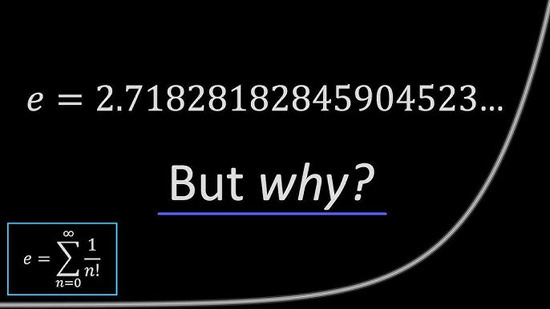
If you attended a humanities program in high school and majored in humanities in college, you might have graduated without studying Euler's number e, the base of natural logarithms. However, these days, if you majored in economics, you would likely encounter natural logarithms and exponential functions in econometrics and growth models, and thus learn about Euler's number e.
To explain Euler's number e, think of it as a benchmark that describes the rate of change most naturally. First, looking at the number, e is an endless decimal like 2.71828..., but the important question is why such an infinite decimal arises.
For example, imagine a situation where you deposit money in a bank and receive interest. If you receive interest once a year, it is added once a year, but if it is added twice a year, it increases a bit more, and if added four times, it increases even more.
So, what happens if interest is added every day, or almost every moment? When you calculate it, it takes the form of (1 + 1/x) raised to the x power, and as you make x larger and larger, the value approaches a certain number and no longer increases significantly. The number that appears at that point is e.
In other words, e is a value that represents the maximum limit reached when something is increased infinitely often by a small amount. Because of this property, e is perfectly suited to explain phenomena such as growth, decay, and change. The rate at which bacteria reproduce, the process of hot water cooling, and the pattern of population growth do not increase all at once but change continuously by small amounts. This continuous change is most neatly expressed by an exponential function with e as its base.
Another interesting point is that functions with e as their base retain their form even when differentiated. In simple terms, when you find the rate of change, it results in the function itself again. Therefore, mathematicians refer to e as the most natural benchmark for growth. This is where the term base of natural logarithm comes from.
Logarithms are the opposite concept of exponents, and when using e as a base, the calculations become remarkably simple. Ultimately, Euler's number is not a strange number but a number that conveniently explains how the world changes. In this sense, e can be seen as a number closer to a narrative than a formula.
In South Korea, the term natural constant is often used for e, but it is not an official mathematical term. Even organizations like the Korean Mathematical Society, which organizes and adopts mathematical terminology, clearly list e as the base of natural logarithms, and you won't find the term natural constant in standard Korean dictionaries or major encyclopedias.
When there is no suitable translation in Korean, terms from English-speaking or European contexts are often adopted, or they settle through Japan, but the origin of this expression is unclear. More interestingly, the term natural constant is rarely used in English. When referring to natural constant in English, it typically brings to mind physical constants like the speed of light or Planck's constant, rather than a mathematical constant.
When referring to e in mathematics, most simply call it the number e or use the name Euler's number. The situation is similar in Japan, China, and Europe. In Japan, they do not use the term 自然定数 but refer to it as Euler's number, and in China, it is called 欧拉数, distinguishing it by Euler's name.
The reason is simple. There are so many numbers named after Euler. The Euler constant, which we often confuse, is referred to separately as Euler's constant, and Euler's sequence, Euler's number, and Euler's polynomial are all clearly distinguished by different names. However, it seems that only in Korea has the ambiguous expression natural constant spread, and it is unclear when this term began to be used.
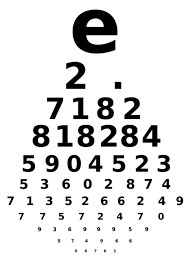
That said, to discuss Euler's number more academically, the base of natural logarithm e and the constant π appear in completely different contexts, yet both are transcendental numbers, making them strangely similar.
π starts from a very simple shape, the circle, and is defined as the ratio of the circumference to the diameter. In contrast, e arises in contexts like interest on money or the continuous change of a quantity over time.
One arises from spatial ratios, while the other comes from the accumulation of change, making their starting points completely different. Yet, as you delve deeper into calculations, both become endless decimals and irrational numbers that cannot be precisely expressed as fractions.
Just as π is the most natural benchmark for explaining circles, e is the most natural benchmark for explaining growth and decay. Thus, while the two numbers belong to different fields, they occupy a similar position in revealing the fundamental structure of nature.
In fact, as you continue to study and research mathematics, there are times when it feels like you are discovering things that existed originally rather than rules created by humans. From that perspective, four core mathematical concepts can be identified.
The first is 1. It is the starting point of existence and the basis of all numbers.
The second is 0. It is a revolutionary concept that expresses nothingness as a number, completely changing calculations and logic.
The third is π. It reveals the essence of space in that an endlessly continuing ratio emerges from the simplest form, the circle.
The fourth is Euler's number e. It is the number that most naturally explains the rate of change and growth in a constantly changing world.
These four are closer to concepts than formulas, and I believe it is more fitting to say that we discovered what was created by a higher power rather than something humans made.






 Magic Cabbage School of Martial Arts |
 Vacation on Hawaii |
 morvex37 |
 Ari Songhan American Immigration Life |
 Bearded Strawberry Smoothie |
 newyorker 101 |
 Things to Do to Buy a House |
 International Court |
 Lunch and Dinner Mexican Taco |
 U.S. Weather Bureau News |
  Korean Mom |
  My NYC |
  moo moo |
  Mr Oh |
  forevergee |
  festival |
  manchester |
  constant |
  Leapfrog Move |
  vibranto |
  Tora Tora |
  yellowbutter |
  Dolly |
  US Embassy |
  NYC saladbar |
  Finding Superfoods |
  lightyear |
  song bang |
  vexomo |
  Indiana Jones |