

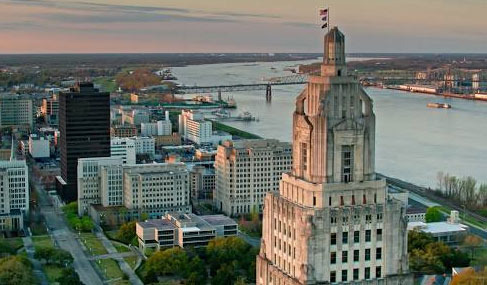
Politically, Baton Rouge is the center of Louisiana, housing the state capitol and major government institutions. Notably, the Louisiana State Capitol is famous for being the tallest state capitol building in the United States, serving as a stage for politicians and a site for historical events. Civil rights movements and issues related to racial equality have actively taken place in this city, adding political depth and significance.
Economically, it is known as the "City of Energy," with a strong presence in the oil and gas industry. The refining and chemical industrial complex developed along the Mississippi River supports the city's economy, and recently, there have been attempts at transitioning to renewable energy and sustainable industries. This gives Baton Rouge an impression of being a forward-looking and industrially diversified city, moving beyond its past image as an industrial town.
The educational and academic aspects are also noteworthy, particularly with the presence of Louisiana State University (LSU). LSU excels in various fields such as agriculture, engineering, business, law, and medicine, contributing to Baton Rouge's reputation as a knowledge-based city. The LSU Tigers' football games are also a cultural event that puts Baton Rouge on the national map. The cheers and excitement of fans gathering in the stadium on Saturday evenings symbolize the city's identity.
Culturally, the unique fusion of influences from France, Spain, Africa, and the Caribbean stands out. This is evident in architecture, music, and food, especially in Cajun and Creole culinary traditions, which have established Baton Rouge as a city of flavors. Dishes like gumbo and jambalaya are major attractions for both locals and tourists. The blend of blues, jazz, and country music brings artistic diversity to life.
In terms of lifestyle, a warm and friendly community culture is strongly established. Despite being a large city, it maintains a small community atmosphere, which can be attributed to the Southern hospitality and warmth. Parks and green spaces along the Mississippi River provide residents with relaxation and leisure.
Often appearing as a backdrop in movies and dramas, Baton Rouge has built a unique image in popular culture. The riverside scenery, historical buildings, and the distinctive Southern ambiance make the city appear even more special.
In summary, Baton Rouge is a city with diverse faces, serving as a political center, industrial hub, academic and sports focal point, and a multicultural crossroads. At the same time, due to its warm community, flavors, music, and history, Baton Rouge has established itself as a symbolic city representing Southern culture, transcending its role as merely the capital of Louisiana.





 ultron78 |
 garlic bread |
 Sugar Cream Door Bulletproof Noodles |
 urbanmint |
 |
| 
 cherrydino |
  ORAVEZIN Oppa |

 berrypup |
  forevergee |
  festival |
  manchester |
  constant |
  Leapfrog Move |
  vibranto |
  Tora Tora |
  yellowbutter |
  Dolly |
  US Embassy |
  NYC saladbar |
  Finding Superfoods |
  lightyear |
  song bang |
  vexomo |
  Indiana Jones |
  meloncat |
  novapixel |
  mortrix |
  Esther 1983 |