

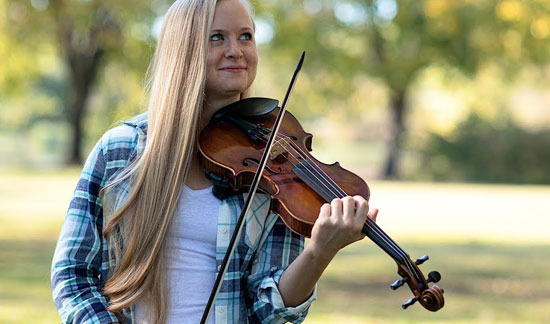
When Koreans think of the violin, images of classical music, orchestras, childhood lessons, and competitions come to mind.
However, in rural America or the Southern/Appalachian regions, the same instrument has a completely different name and culture.
It is called a fiddle, and the person who plays it is a fiddler. Although they look the same as a violin, fiddle culture stands in stark contrast to the strictness of classical music.
The culture of fiddlers originated from the folk music brought by European immigrants. The fiddle was the instrument that farmers, miners, shepherds, and immigrant workers used to enliven festivals or dance in taverns. There were no sheet music, formal attire, or concert halls. They simply learned by "listening and following" and enjoyed playing in front of people, which was proof of their skill. While the violin in Korea symbolizes 'classical education,' the fiddle in America represents 'the sound of the common people, the song of life.'
What feels strange from a Korean perspective is that fiddlers do not place much importance on technical skill. Of course, those who are good are treated like stars, but it is not the flashy skills that earn respect; rather, it is how much they can bring excitement, make people dance, and lead the atmosphere spontaneously that matters. Even if the pitch is slightly off, it is accepted as part of their individuality. Instead of demanding "accurate pitch, perfect bowing, and faithful interpretation of the sheet music" like in classical music, showing one's own style is considered skill.
Another unfamiliar aspect for Koreans is that fiddlers are also singers and dancers. They sing while joking with guests, play while tapping rhythms with their feet, and even climb onto tables while moving around the stage. This is something unimaginable in a classical performance. As a result, fiddle culture feels more like a 'place to have fun together' rather than an 'art performance.'
Additionally, fiddle music has developed differently in various regions. Styles vary from Appalachian fiddling in Kentucky and Tennessee, Texas fiddling, Irish fiddling, to Celtic fiddling in Eastern Canada. Some places focus on fast dance tunes, while others center around lyrical folk songs. In other words, fiddle culture embodies the identity of local communities rather than a national identity. Korea has a relatively homogeneous music education environment, making it difficult to encounter such regionally-based artistic cultures.
Currently, in the U.S., fiddlers are recognized as artists with a distinct identity separate from classical violinists. A fiddler who gets 3,000 people to dance at a rural festival can be a local hero, more so than a performer who earns a lot of money at Carnegie Hall. When children take violin lessons, they may be asked, "Do you want to learn classical or fiddle?" This means choosing between 'hobby and emotion' even with the same instrument. It is a completely different culture from the linear path of 'prestigious music college → orchestra → professional' in Korea.
Ultimately, the world of fiddlers is not in opposition to classical music but is another violin culture with a different language and approach.





 Korean Mom |
 novapixel |
 Peter Pan Pet |
 horse |
 Sunset Oregon |
 Weekend Movie Blog |
 Beauty, Health, Lifestyle Blog |
 coloradoman |
 Superman Cat Blog |
 Noodle Noodle |
  Tonky |
  viroma |
  cookie |
  Live and that's it |
  Alright Twain |
  eatontown blog |
  HAWAII Korean Church News |
  Amore |
  linex |
  Balancework |
  laro90 |
  MEDBIO American Doctor Blog |
  SWAT TEAM BLK |
  DREAM BIG |
  frostbite |
  330 Forever My Love |
  El Dorado |
  dralix58 |
  Gorama Round |
  Skydiving |