

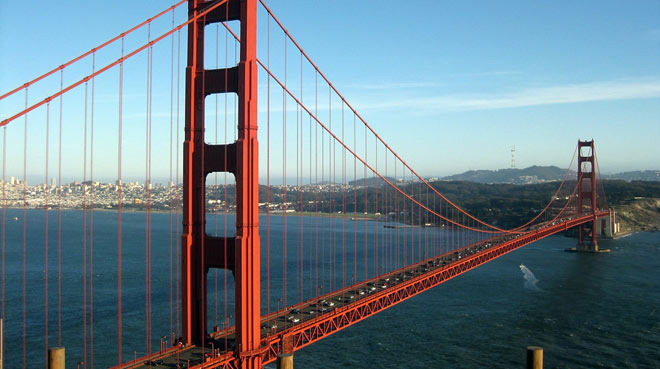
The Golden Gate Bridge is one of the most famous bridges in the United States and symbolizes the city of San Francisco. The name "Golden Gate" does not come from the color or shape of the bridge itself, but from the name of the strait it spans, the Golden Gate Strait.
This strait was named "Golden Gate" in the mid-19th century, as it served as a gateway to the west during the American westward expansion. The bridge built over this gateway became known as the Golden Gate Bridge, symbolizing San Francisco as an entrance to a land of new opportunities.
When you see the Golden Gate Bridge in person, it is much larger and more majestic than it appears in photos, giving it the feel of a work of art rather than just a landmark. Knowing the era in which this bridge was built adds to the awe. The Golden Gate Bridge was constructed during the 1930s, a time when the United States was struggling through the Great Depression. As the need for a bridge connecting San Francisco and Marin County grew, the project began, and building one of the world's longest suspension bridges over the ocean was nearly a challenge with the technology of the time.
The designer, Joseph Strauss, introduced a completely new structure that was different from existing methods, and after numerous trials and errors, it was finally completed in 1937. At about 2.7 kilometers long, this bridge was truly an innovation for its time.
What people most remember about this bridge is its color. The distinctive reddish hue was not just for aesthetic purposes; it was a functional paint color chosen to prevent corrosion of the steel due to strong sea winds and salt. However, because the color is so striking, it has become an iconic feature unique to the Golden Gate Bridge.
While it may appear soft and elegant, this bridge possesses incredible durability. It was designed to withstand strong winds, seawater corrosion, and the earthquakes that are common in San Francisco. Recently, extensive seismic retrofitting has been undertaken to ensure it can endure earthquakes of magnitude 8 or higher.
Thus, the lifespan of the Golden Gate Bridge is not simply a matter of being an "old bridge"; as long as it is maintained, it is essentially close to being permanent. Every year, the steel structure is repainted, and the cables and bridge surface are regularly inspected and replaced, ensuring continuous maintenance. In a sense, the bridge is managed like a living structure.
Ultimately, the Golden Gate Bridge feels like both a legacy of the past and a structure that continues to evolve in the present. I believe the reason it captivates anyone visiting San Francisco is due to the history, engineering, and the countless memories associated with it.
It seems that this bridge will remain the face of San Francisco for a long time to come.




 candytip |
 Gold Bar |
 Pirate Ship Popcorn Maker |
 Montgomery Mom |
 Anjollinya Blog |
 Peter Pan Pet |
  Nuchuhan Exploration BLOG |
 Sugar Cream Door Bulletproof Noodles |
 Moscow Kim |
 US Embassy |
  Korean Mom |
  My NYC |
  moo moo |
  Mr Oh |
  forevergee |
  festival |
  manchester |
  constant |
  Leapfrog Move |
  vibranto |
  Tora Tora |
  yellowbutter |
  Dolly |
  NYC saladbar |
  Finding Superfoods |
  lightyear |
  song bang |
  vexomo |
  Indiana Jones |