
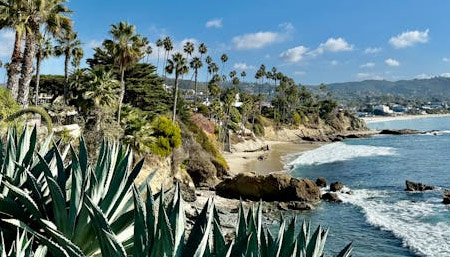
There is an interesting correlation between California's desert climate and the cold California current.
While they are not directly connected, they both play important roles in shaping the unique climate of the California region.
First, let's take a look at the California current. The California current is a cold current that flows down from the North Pacific.
This current flows south along the Pacific coast and has a significant impact on California's coastal climate.
The cold seawater cools the air in the coastal areas and retains more moisture.
As a result, fog often forms in the mornings near the coast, and relatively mild weather can be maintained even in summer.
In contrast, the inland areas of California, especially the desert regions, show a completely different climate.
The desert climate is generally dry and very hot during the day, but temperatures drop sharply at night.
This is because the cold air from the Pacific does not penetrate deeply into the inland areas.
This is due to the high mountain ranges (e.g., Sierra Nevada) that block the cold sea winds between the California coastline and the inland areas.
By blocking the cold sea winds, these mountain ranges allow hotter and drier air to dominate the inland regions.
At the same time, while the California current maintains moisture near the coast, this moisture cannot cross the mountain ranges, so it brings very little rain to the inland areas.
As a result, the inland areas are experiencing desertification, creating an extremely dry environment with a lack of water.
Interestingly, thanks to the combination of this cold current and desert climate, California has become a unique region with "diverse climate zones."
Near the coast, there is fog and a mild climate, while the inland areas have a hot and dry desert environment.
Thus, in California, you can experience completely different climates just by driving for an hour.
In conclusion, California's desert climate is closely linked to the cold California current.
The current supplies cool and moist air to the coastal areas, but the mountains block that air, creating a hot and dry environment inland.
These two elements play a crucial role in forming California's diverse climate.




 Weekend Movie Blog |
 Beauty, Health, Lifestyle Blog |
 coloradoman |
 Superman Cat Blog |
 Awesome Blog |
  vibranto |
  Tora Tora |
  yellowbutter |
  Dolly |
  US Embassy |
  NYC saladbar |
  Finding Superfoods |
  lightyear |
  song bang |
  vexomo |
  Indiana Jones |
  meloncat |
  novapixel |
  mortrix |
  Esther 1983 |
  fortbliss |
  Moscow Kim |
  My Two Way |
  toastyfox |
  FLORIDA Acus |