

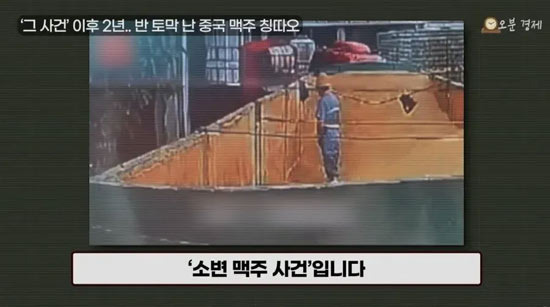
There's a reason why people feel uneasy when it comes to Chinese food products.
There have been incidents involving cardboard dumpling fillings and fake eggs, highlighting bizarre issues with Chinese food.
At this point, isn't it normal to be suspicious of everything consumed from China?
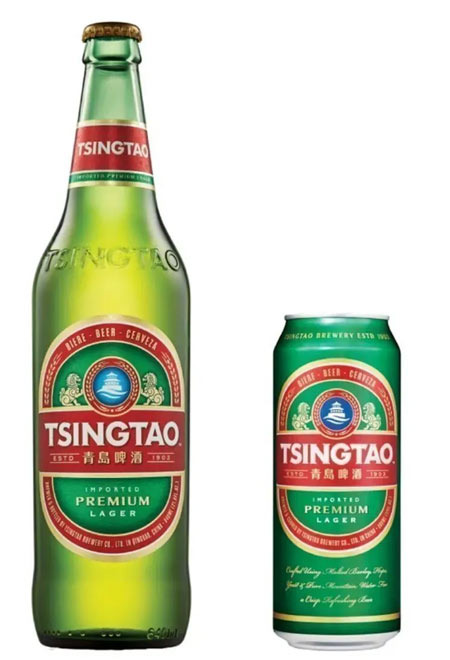
The major incident occurred in 2023 when a video surfaced showing an employee at the Tsingtao Brewery in Shandong Province urinating on beer ingredients.
As this outrageous video circulated, consumers were horrified and began boycotting Tsingtao.
The company claimed, "We produce separately for export?"
However, this statement did little to reassure people and instead fueled further distrust. "Is it okay to urinate on ingredients for domestic beer? How can we trust that export products are truly different?" Ultimately, once trust is broken, it cannot be restored with just a few words.
Interestingly, the market reaction following the incident was immediate. The stock price plummeted, resulting in a loss of several hundred billion won in market capitalization within a day.
This wasn't just a simple mishap; it indicated that investors believed, "This could be a structural issue." Consumers felt the same way. Reports of a 40% drop in sales at convenience stores in Korea suggest that people weren't just complaining; they were actually closing their wallets. Other beer brands filled the gap. Consumers won't buy if they feel uneasy.
What's even more intriguing is the response to the incident. Initially, they mentioned the possibility of the video being manipulated, suggesting that it could be fake due to today's advanced technology.
While this isn't entirely incorrect, the timing is the issue. In a situation where people are already angry, saying "the video might be fake" is essentially pouring gasoline on the fire. Only later did they begin an investigation, seal the ingredients, and detain the employee.
It feels like the order of operations was completely reversed. Trust is determined by the speed and direction of the response, and foolishly, they missed both.
The more fundamental issue is that this isn't the "first time" something like this has happened, haha.
Concerns about Chinese food have been repeated multiple times, from the melamine milk powder scandal to fake cooking oil and cardboard dumpling fillings.
When it gets to the point of "here we go again," it becomes not just a brand issue but a national image problem.
Ultimately, what matters is the structure. Factory management, personnel management, oversight systems, and internal culture are all interconnected.
In this incident, they acknowledged that there were "gaps in raw material transportation management."
In simple terms, it means that the environment allowed for problems to arise if someone was determined to cause them.
And it indicates that there was no system in place to prevent this. They claim they will introduce an AI monitoring system, but that's like closing the barn door after the horse has bolted.
From a consumer's perspective, if they can trust it, they will buy. If they can't trust it, they won't buy.
Once trust is broken, it lasts longer than one might think. This is especially true for food.
Unlike clothes or electronics, which can be replaced if they break, food goes into the body.
If someone thinks, "Is this really okay?" they will likely not purchase it again.
So, the notion that Chinese food is unreliable is a result of repeated incidents, delayed responses, and an incomplete system.
It's bittersweet that the saying, "Tsingtao goes well with lamb skewers," has faded from conversation lately.



 Anova US Beauty Information |
 anchor |
 Korea Tiger News |
 Alpha and Omega World |
 Florida King |
 Sugar Cream Door Bulletproof Noodles |
 my town K blog |
  Nuchuhan Exploration BLOG |
 Sirin Solitude and Advancing Hand in Hand |
 newyorker 101 |
  coffeee |
  |
|  Christopher |
  sylven |
  Sammy Beach |
  Bliss O |
  blue ocean |
  greenlight |
  Watanaka Karametibaksa |
  castle |
  xelton52 |
  carefree |
  vrixen73 |
  AZ Road Master |
  Victory 1988 |
  summita |
  business lim |
  Colorado Lee |
  Make My Day |