

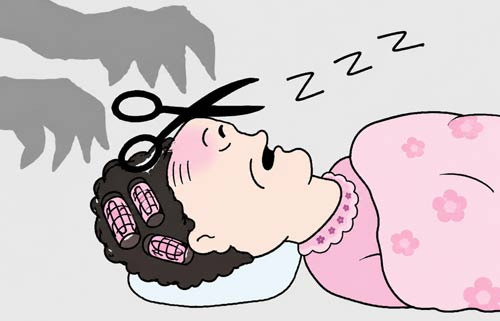
At 3 AM, you wake up but can't move, feeling as if someone is pressing down on your chest. Don't worry too much; it's just a bug in your brain's nerves.
Most people have experienced it at least once. You wake up but can't move your body. Your chest feels tight, and you have the eerie sensation that someone is standing in a corner watching you. In Korea, this is called "gawi-nul-ryeot-da," while in English-speaking countries, it's referred to as sleep paralysis.
Interestingly, different cultures explain this phenomenon in various ways. In Korea, it's attributed to a virgin ghost, in Japan to kanashibari (金縛り), in Newfoundland to the Old Hag, and in Turkey to Karabasan. They all share a similar concept: a dark entity sitting on your chest.
It's fascinating that humanity has created similar stories about the same phenomenon for thousands of years.
Yet, even in the 21st century, many people still interpret this as a "spiritual phenomenon." The fact that content like "amulets to ward off sleep paralysis" on YouTube gets hundreds of thousands of views is a bit frustrating. It's not a ghost; it's a synchronization bug in your brain.
Human sleep is not simply a state of "consciousness being turned off." It's a complex cycle alternating between NREM and REM sleep. The REM (Rapid Eye Movement) stage is when we dream.What's interesting is that during REM, the brain is almost as active as when it's awake. But what if you could move your body during this state? You might fall out of bed while trying to escape in a dream or hit someone next to you while fighting. Evolution has put in place a mechanism called REM atonia to prevent this. During REM, all skeletal muscles are paralyzed except for key muscles like the diaphragm.
Dr. Chad Ruoff from the Mayo Clinic Sleep Medicine Center explains:
"During REM or dream sleep, most people are essentially in a paralyzed state, except for key muscles like the diaphragm." In other words, the paralysis of sleep paralysis is not abnormal; it's a safety mechanism that occurs normally every night.
So what's the problem with sleep paralysis?The bug occurs in the timing. Normally, as you wake up, this REM atonia is released, and consciousness returns. But sometimes the order gets mixed up. Consciousness turns on first, but the body's paralysis hasn't released yet. Michelle Drerup from the Cleveland Clinic defines it as "the mind is awake, but the body has not yet regained muscle control."
There's another variable at play. During REM, the brain circuits that create dreams have not completely shut down. So, both waking consciousness and remnants of dreams operate simultaneously. As a result, you may experience hallucinations of someone standing in the corner of the room, a feeling of pressure on your chest, or auditory hallucinations of someone's breathing. This is the essence of what humanity has referred to as "ghosts" for thousands of years.
Even the sense of time is distorted. According to Dr. Ruoff, "what feels like an eternity may only last a few seconds." Fear stretches time. When the brain perceives a situation as threatening, the processing speed increases, making subjective time feel longer.
Who experiences it more frequently?Statistically, about 10% of the entire population experiences sleep paralysis.
Dr. Ruoff notes that while there is significant variation in figures across studies, it is not a rare phenomenon. This means you are not alone in experiencing it.
Additionally, certain conditions increase the likelihood of occurrence. The data consistently points to the following triggers:
First, irregular sleep schedules and chronic sleep deprivation. Patterns of working late and catching up on sleep over the weekend, jet lag from business trips, and shift workers are more prone to it. Second, sleeping in a supine position (on your back). Third, REM disruption due to sleep apnea. Fourth, psychiatric comorbidities such as anxiety disorders, panic disorders, and PTSD.
One more thing: recent studies have mentioned genetic predisposition. If someone in your family has experienced sleep paralysis, you are more likely to experience it as well. This means that it's not ghosts following your family, but rather the REM control mechanism of the nervous system being inherited.
So how do you resolve it?The key to treatment is eliminating the root cause. It's about assessing how uncomfortable your sleeping environment is and making it more comfortable. Poor temperature or position can make you more susceptible to sleep paralysis.
If you have underlying sleep disorders like sleep apnea or narcolepsy, address those first. If the frequency is severe and significantly impacts your quality of life, medications that suppress REM sleep can be used. As Dr. Drerup mentioned, SSRIs are a representative example. Reducing REM itself decreases the likelihood of REM-related paralysis leaking into wakefulness.
There are also many things you can do without medication. Going to bed and waking up at the same time every day, ensuring sufficient sleep duration, avoiding sleeping on your back (sleeping on your side), and managing stress before bed. It may sound cliché, but data supports its effectiveness.
And when an episode occurs, the advice from Dr. Drerup is clear. Don't panic. Remind yourself that this is temporary and not dangerous. Focus on your breathing slowly, and try to move small muscles like your fingers or toes to help the paralysis release more quickly. If you panic, the sympathetic nervous system goes into overdrive, making it last longer.
Sleep paralysis is a failure of synchronization between the recovery of consciousness and the release of muscle paralysis in the human nervous system. It's not a mystery; it's an engineering issue.Of course, it can be frightening when experienced firsthand. I have also experienced it a couple of times due to stress when I was tired. I felt something pressing down on my chest and saw eyes in the corner of the room. It was scary. But just because it's frightening doesn't mean it's a supernatural being. The unknown is scary, and what is frightening is often perceived as a ghost.
This has been the case throughout human history. Thunder was seen as the wrath of the gods, and plagues were viewed as curses from witches. Sleep paralysis falls into the same category.
In the 21st century, we have better tools for explanation. We have polysomnography, neuroscience, and decades of clinical data on REM mechanisms. Instead of seeking amulets when experiencing sleep paralysis, I believe the modern approach is to first check and improve your sleep patterns.
 joyfulfor
 mintrivertraveler1965






 anchor |
 Korea Tiger News |
 Alpha and Omega World |
 Florida King |
 AH LALA |
 Study Abroad Life Know-How Tips |
 Sunny's Travel in America |
 novapixel |

 Victory 1988 |
  stalion |
  Smile Face |
  The Long Shot |
  Investment Beginner Company Information Encyclopedia |
  sweetfox |
  ceporta |
  H Leader |
  My tracks |
  Yes Dorian |
  novent |
  calviro |
  Enjoying Samba at Home |
  Once in a Lifetime |
  Banana |
  rouge88 |
  toffee |
  King County |