

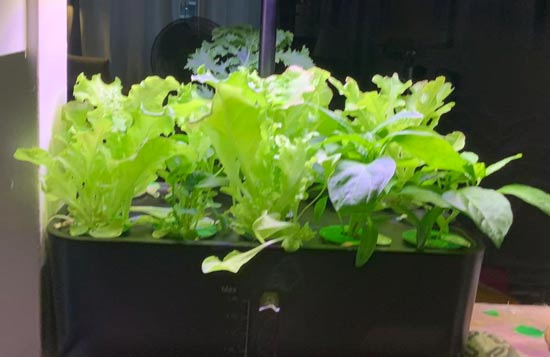
I live in an apartment in downtown LA that is relatively modern and well-maintained.
The view from my window shows the skyscrapers of DTLA and the cars lined up on the 110 freeway all day long... It is clear that this is far from 'nature'.
However, when I tell someone that I am growing lettuce right in the middle of this urban environment, they are all surprised.
There is no soil, no large garden, and no balcony flower bed. Yet, the vegetables grow well.
The secret is hydroponics. I started hydroponics purely out of curiosity.
While searching for "growing plants without soil" on YouTube, I ended up ordering a kit for $80 from Amazon.
I started with lettuce, but now I am also growing arugula, basil, mint, and cherry tomatoes.
Farming in the city may sound absurd.
But hydroponics is different.
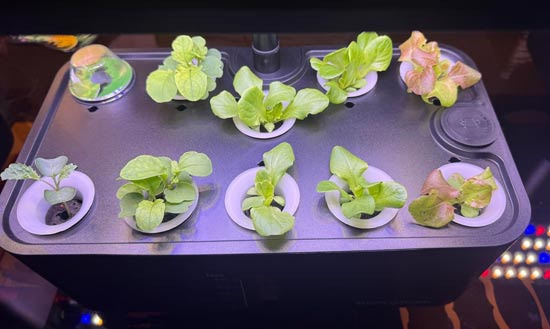
It does not require land. A small space is enough. Even on days with insufficient sunlight, LED lights can solve the problem.
In a city like LA, where real estate is expensive and land is scarce, the advantages of hydroponics become even more apparent.
You can utilize narrow spaces vertically, and since it can be grown indoors, apartments, offices, and even parking lots can be transformed into farms.
California, especially LA, faces serious water shortages.
In the summer, there are warnings about water outages, and campaigns to replace lawns are often launched.
However, hydroponics uses only one-tenth the amount of water compared to traditional agriculture.
Moreover, the water is recycled, so it is not wasted. The hydroponic pump circulates water very quietly.
This method, which is sustainable, eco-friendly, and conserves water, is gaining attention as an agricultural model for the era of climate change.
Every morning, as I make a salad with the vegetables I have grown, I feel that I have my own little sanctuary in this city.Caring for plants goes beyond a simple hobby; it leads to psychological stability. In a life saturated with digital devices, the emotional comfort of growing vegetables is quite significant.
In fact, hydroponics is not just a hobby. More and more people are starting urban smart farms by utilizing warehouse buildings in downtown LA or the rooftops of old buildings. They are building fully automated indoor farms equipped with LED lights, automatic watering systems, and temperature control sensors.
In fact, some startups are supplying vegetables grown through hydroponics to restaurants and organic markets right in the heart of LA.
Since the distance for ingredient delivery is short, the freshness is top-notch. The days when being called an urban farmer seemed like a joke are long gone.
For urban dwellers living in a world covered with asphalt and concrete, the word green is becoming increasingly urgent.



 Khan Film Blog Production |
 dermoon |
 hoosierdaddy |
 sun walker |
 Let's Be Like a Salt-like City Person |
 Weekend Movie Blog |
 Beauty, Health, Lifestyle Blog |
 coloradoman |
 Superman Cat Blog |
 Victory 1988 |
  Korean Mom |
  My NYC |
  moo moo |
  Mr Oh |
  forevergee |
  festival |
  manchester |
  constant |
  Leapfrog Move |
  vibranto |
  Tora Tora |
  yellowbutter |
  Dolly |
  US Embassy |
  NYC saladbar |
  Finding Superfoods |
  lightyear |
  song bang |
  vexomo |
  Indiana Jones |