

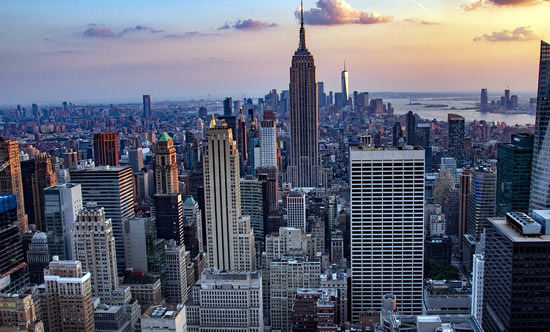
Thirty years ago, saying "I work in Manhattan" or "I have an office in Manhattan" was a symbol of social status.
Like in Korea, Manhattan was a symbol of success and wealth worldwide, and there was a time when just the name New York Manhattan was a source of envy.
However, after the September 11 attacks in 2001 and the pandemic in 2020, the city suffered significant wounds. Wall Street, the heart of finance, came to a halt, and with the increase of empty offices and shops, there were even talks of "the end of the Manhattan era." Today's Manhattan has become a city where past glory and present reality coexist.
Nevertheless, the name Manhattan remains one of the most famous city names.
Looking at the origin of the name, we can see that Manhattan was built on a history of change and adaptation. The name Manhattan comes from the language of the Lenape people, who lived in the area in the early 17th century. The original pronunciation is closer to "Mannahatta," which is interpreted as "island of many hills" or "land of many hills." Although it is now covered with concrete and glass buildings, it was originally a natural island with forests, rocks, and small hills.
In 1626, Dutchman Peter Minuit purchased the island from the natives in a barter exchange, marking the beginning of the city's history, and it later became a British colony, solidifying the name Manhattan. From the late 19th century, skyscraper construction began in earnest, transforming it into the center of global finance and commerce, and by the 20th century, New York itself became a symbol of the world. However, beneath this glamorous city, practical issues have always existed. One of them is the ground issue.
The ground in Manhattan can be broadly divided into two types. Some areas of Midtown and Lower Manhattan have a shallow distribution of solid bedrock, making them very favorable for skyscraper construction. In contrast, areas like SoHo, Tribeca, the East Village, and the Lower East Side were once marshlands with alluvial soil, resulting in relatively weak ground due to deep bedrock and abundant soil.
These areas have undergone significant changes in natural topography due to landfill and rapid urban development, and as a result, subtle ground subsidence has been observed over time. Recent studies indicate that some areas experience an average annual subsidence of about 1-2mm, which may seem small, but in conjunction with rising sea levels, it poses a significant long-term burden. Particularly, areas adjacent to the financial district, East River, and Hudson River are assessed as zones where subsidence and flood risks act simultaneously.
Amid these structural issues, the Manhattan commercial real estate market is facing another significant turning point. With remote work becoming commonplace after the pandemic, the demand for traditional office space has sharply declined, and vacancy rates in Midtown and the Financial District once soared into double digits. Old office buildings are beginning to be remodeled for hotel, residential, or mixed-use purposes, indicating a shift in the city's usage itself.
However, it is difficult to say that Manhattan's commercial real estate is in decline. Its status as a hub for finance, media, tech, law, and entertainment industries remains strong. However, it is not the same as before. The structure is being reconfigured from large single-tenant office centers to small premium offices, flex offices, and mixed commercial spaces. Hudson Yards, near Grand Central, and some areas downtown still attract global capital's attention.
Ultimately, Manhattan was a city built on the limits of nature and structure, just as its name's origin suggests. It is true that its status has been shaken by historical shocks like 9/11 and the pandemic. However, this city has always survived by changing its form in times of crisis.
I believe that Manhattan's future will not be one of decline but of reconfiguration. In real estate, while people say it will fail, very few actually do.


 moo moo |
 ultron78 |
 garlic bread |
 Sugar Cream Door Bulletproof Noodles |
 urbanmint |
  newyorker 101 |
 Things to Do to Buy a House |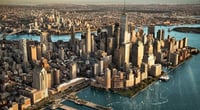
 U.S. Weather Bureau News |
 International Court |
 NYC saladbar |
  Tonky |
  viroma |
  cookie |
  Live and that's it |
  Alright Twain |
  eatontown blog |
  HAWAII Korean Church News |
  Amore |
  linex |
  Balancework |
  laro90 |
  MEDBIO American Doctor Blog |
  SWAT TEAM BLK |
  DREAM BIG |
  frostbite |
  330 Forever My Love |
  El Dorado |
  dralix58 |
  Gorama Round |
  Skydiving |