

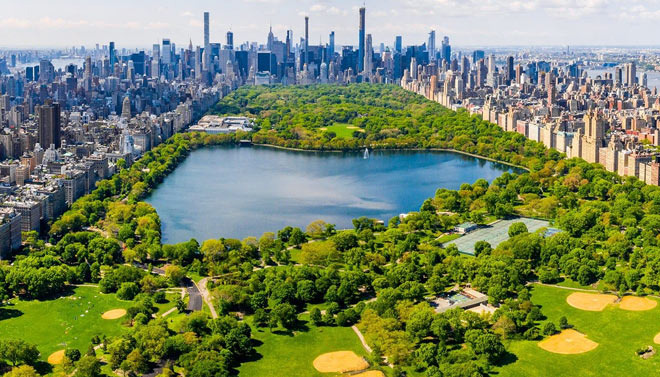
When people think of New York, they usually picture a forest of buildings: Times Square, yellow taxis, subways, and bustling crowds.
However, those who have lived in New York for a while tell a different story. They say, "New York is surprisingly a city with many parks."
Honestly, walking all day among concrete buildings in Manhattan can be suffocating. Eventually, you come to understand why New Yorkers are so obsessed with Central Park.
Central Park is not just a neighborhood park. It feels like a massive green space forcibly inserted into the heart of Manhattan.
Covering about 840 acres, considering New York's real estate prices, it's a space that could hardly be recreated today. It was established in 1858, and the very idea that "a city needs such a vast park" back then is remarkable. Designed by Frederick Law Olmsted and Calvert Vaux, it was a project that fundamentally changed the structure of New York City.
When you first visit Central Park, everyone seems to say the same thing: "Is this really Manhattan?" Walking between skyscrapers, you suddenly find yourself on a forest path, by a lake, with squirrels running around. The Mall, a walking path, has appeared in so many movies that it feels oddly familiar when you see it in person.
The area around Bethesda Terrace is always busy with tourists taking photos, and Strawberry Fields still attracts fans of John Lennon.
New Yorkers really know how to utilize their parks. In Korea, parks are often just places for a stroll, but it's different in New York.
In the morning, you see joggers; at lunchtime, office workers lying on the grass; and in the evening, people riding bikes—all day long, the park is alive.
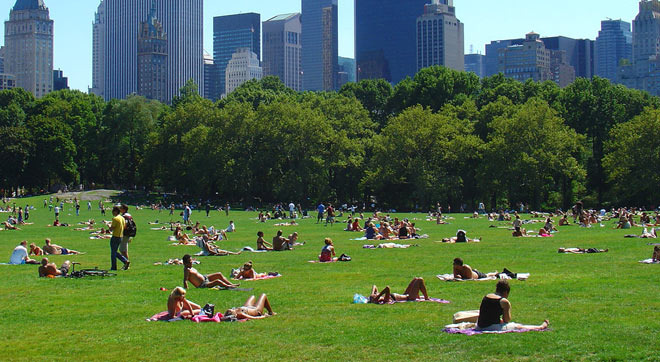
In the summer, the lawns are filled with people lying down and reading books.
At first, I thought, "Do they really spend their time so leisurely?" But in a hectic city like New York, such moments seem essential.
In winter, the Wollman Rink transforms the atmosphere. You could say that most of the winter scenes in movies are filmed here.
The downside is that there are a lot of people, and the prices are not cheap. In New York, you can't escape the conversation about money, no matter what you do.
Prospect Park in Brooklyn is also quite nice. Designed by the same creators as Central Park, it has a similar vibe, but with fewer tourists, many locals prefer it. In the summer, outdoor concerts and family picnics are common. The unique hip atmosphere of Brooklyn adds a different feel.
Near Flushing, where many Koreans live, is Flushing Meadows-Corona Park.
This is the site of the World's Fair, famous for the Unisphere structure. Many Korean families visit here. On weekends, you can easily see Korean parents playing ball and riding bikes with their kids. The fact that there is such a large space in the middle of New York is quite rare.
Riverside Park stretches along the Hudson River, and walking here while looking at the river gives you a different perspective of New York. Manhattan can be so hectic that a moment of respite in a riverside park is necessary. People often say New Yorkers are impatient, but in the park, everyone seems to be sitting back and relaxing. It's quite fascinating.
Pelham Bay Park in the Bronx is enormous. It's the largest park in New York, featuring hiking trails, a golf course, and a beach. Honestly, seeing places like this makes you realize that New York is not just a city of buildings.
Ultimately, the true meaning of New York's parks seems to be "an escape within the city." With high housing costs, crowded streets, complicated subways, and a stressful environment, stepping into a park provides a moment of relief. New Yorkers are not just obsessed with a small patch of grass for no reason. In this city, green spaces can feel like essential areas for survival, not just places to relax.
 SunJourney
 CookieRunCrew
 puffp8




 Anjollinya Blog |
 Taco Seattle |
 Mr Song Song |
 Living Economy Information Blog |
 Blog Korea |
 newyorker 101 |
 International Court |
 Poppin News |

 Things to Do to Buy a House |
  alamo |
  Lol Life |
  Waiting for Godot |
  parlon |
  Say Yes in English |
  Sayonara H |
  rigid |
  Ohio Ohayoung Hello |
  U.S. Military Recruitment Information |
  You Turn Me On |
  DaeBak Electronics CNET |
  solid90 |
  elion |
  xylora |
  Study Abroad Life Know-How Tips |
  cheesepup |
  carpflow |
  mapsina |
  Softy |