

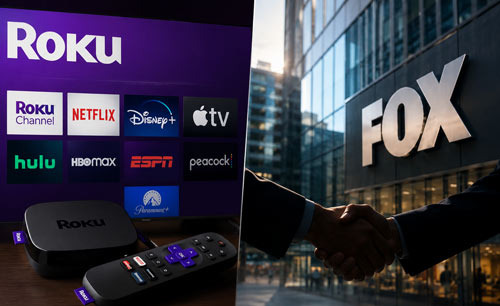
A "game-changing" big deal has erupted in the media industry.
Media giant Fox Corp. has agreed to acquire the hidden powerhouse of streaming platforms, Roku, for a staggering $22 billion.
Roku? Many might wonder, but anyone familiar with the TV market would first react with, "Wow, Fox bought that?"
This is because Roku is like the hidden final boss in the TV industry.
What does Roku do to be worth $22 billion?
Simply put, if there are Android and iPhone in the smartphone world, Roku exists in the U.S. TV world.
Originally, Roku was a Netflix internal project.
When Netflix was transitioning to streaming, it spun off to create a set-top box that allowed viewers to watch Netflix on TV, and that company became Roku.
The Roku box, launched in 2008, was revolutionary.
This was during a time when smart TVs were almost nonexistent.
However, the real jackpot was not the set-top box.
Many TVs sold in the U.S., such as TCL, Hisense, Sharp, and RCA, now use the Roku operating system.
When Americans turn on their TVs, the first screen they see is Roku.
In other words, TV manufacturers build the house, and Roku has taken over the front door of that house.
But how does Roku make money?
Many people think of Roku as an electronics company, but it is actually much closer to an advertising company.
As of 2025, Roku's revenue was around $4.2 billion.
Interestingly, most of this revenue comes from advertising and platform services.
Money made from selling set-top boxes or remotes is far less important than advertising.
Roku knows what users are watching.
Whether they are watching Netflix, YouTube, or ESPN, how many hours they turn on the TV, and which ads they click are all collected as data.
If Google has internet search data, Roku has the living room data of Americans.
This is why advertisers love Roku.
This is the reason why advertising dollars keep flowing in.
In fact, Roku has secured over 100 million active accounts worldwide.
It is not an exaggeration to say that a significant number of American households are already part of the Roku ecosystem.
Why did Fox spend $30 billion?
Fox is already rich in content.
It owns Fox News, Fox Sports, FS1, Big Ten Network, and the free streaming platform Tubi.
There is news, sports, and drama.
However, there is one thing it lacks.
That is a platform.
Netflix has both content and a platform.
YouTube is the same.
But Fox creates content but ultimately had to rely on others' platforms.
Through this acquisition, Fox will gain control of the screen that Americans see first when they turn on their TVs.
In simple terms, it has transitioned from being a tenant to becoming a landlord.
What is the real significance of this deal?
This acquisition is not just about a broadcaster buying a streaming company.
It is an event that shows where power in the media industry is shifting.
In the past, it was said that "content is king."
Now, it is different.
"The platform is king."
No matter how good the content is, the company that controls the entrance where consumers come in is ultimately the strongest.
A small project that started in a corner of Netflix's office 20 years ago has now become a $22 billion giant.
And Fox is trying to take over the entire entrance to the U.S. TV market by acquiring that giant.
The reason Netflix, Disney, Amazon, and Comcast were all mentioned as potential acquirers of Roku is precisely because of this.
Ultimately, this deal is more accurately viewed as a war over who will control the remote in American living rooms.
 NewMexicoPal
 SunnyHeart







 Yonori Nori |
 Hawaiian Dooly Mom |
 Google Idea |
 Maximum Pro |
 Illinois Mom |
 Things to Do to Buy a House |
 International Court |
 TungTung's Dad Blog |
 Key spots |
  Community Cross |
  Wenda |
  Roman Pan |
  Nuchuhan Exploration BLOG |
  Who's watching? |
  Strawberry Pancake Warrior |
  What can make money? |
  Egg Steamed Pot |
  New Jersey News Local Stories |
  Study Abroad Life Know-How Tips |
  My Love DS |
  Leapfrog Move |
  US Regional Information Local News |
  Finding Superfoods |
  COLO COLO |
  morixa |
  nero kim |
  USA Hyundai Kia |