

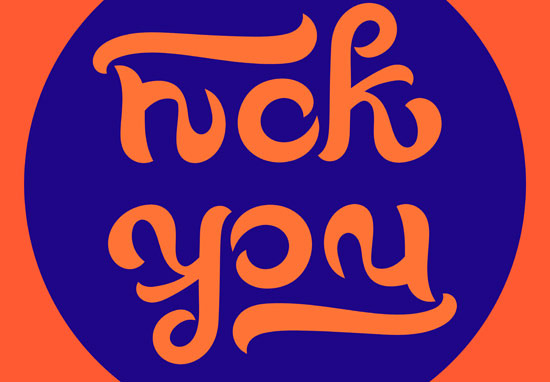
Is this person angry or complimenting me? Their expression is smiling, but...
It seems that everyone finds it challenging to understand how Americans use the word "fuck" at first.
While this may seem like a funny topic, it is quite important in reality.
Imagine a client in a meeting saying, "What the fuck is going on with this deadline?"
What? Fuck? Are they out of their mind? Are they cursing at me? You shouldn't get upset.
That person is just expressing their frustration about a delayed situation in an exaggerated way.
So, if you don't understand the grammar of this word's usage, it can make working in an American office difficult.
From a linguistic perspective, this is a truly genius word
Just as the word "really" can be used as a noun, adverb, or adjective in Korean, "fuck" covers almost all parts of speech in English.
Noun, verb, adjective, adverb, interjection. It can even be used as an insertion in the middle of a sentence.
It creates a linguistic phenomenon called "infixation," as in "Abso-fucking-lutely."
In linguistics, this is referred to as an intensifier.
"It's cold" and "It's fucking cold" convey the same information, but the emotional intensity is different.
Americans use this word as a tool to adjust that intensity.
So, before being a curse, this is a matter of language function.
From my experience working with colleagues, the more technically skilled someone is, the more they tend to use this word for emphasis.
Perhaps people who value accuracy want to convey the intensity of their emotions precisely.
Of course, this is just my personal observation; it could be right, or it could be BS, considering Trump uses this word often.
Context is everything
After living in the U.S. for nearly 15 years, I've realized a clear rule: this word is entirely context-driven.
When watching the NFL with friends, saying, "What the fuck was that play?" is just like saying, "That play was crazy."
However, if you say that in an HR meeting, you'll get a warning that day.
The same word, completely different outcomes. American society is very clear about this boundary.
Among teenagers and people in their twenties, it is practically used like a comma.
Listening to today's kids, it's not an exaggeration to say that one in three words is "fuck."
What kind of conversations are happening... lol, it's like a default every time they breathe...
On the other hand, in formal presentations, client meetings, or family gatherings, they switch to a completely different language mode.
If someone can do this skillfully, they are a well-socialized American.
The sanitized versions are also interesting.
Words like "Fudge," "Frick," and "Eff" sound similar but can be used in front of kids depending on the situation.
"What the fudge is going on with this timeline?"
"Who the frick worked on this section?"
"Ah, eff... give me a second."
"This bug is freaking annoying."
"Why is this freaking thing not working?"
Here, "freaking" is essentially a completely safe substitute for "fucking." It's a version you can use without worrying about HR.
So, this is a kind of social agreement. Everyone knows, but they don't cross the line.
The reason these expressions are interesting is that they are not just "mild curses" but represent "American social awareness and distance management skills."
The media and pop culture have changed the game
The role of the media has been significant in normalizing this word.
Back in the 1980s, if this word appeared in a movie, it was almost guaranteed to receive an R rating.
Now, it occasionally appears in Netflix dramas, podcasts, and even TED talks.
As hip-hop music became mainstream, the frequency of exposure to this word exploded.
Generations that grew up in the 2000s have already encoded this word in their brains as an "emotional expression tool" rather than something "shocking."
So, for those under 30, it's honestly not that shocking anymore.
However, that doesn't mean it has become completely neutral. When this word comes up in public settings, it still makes the news.
I've seen politicians apologize after unknowingly using this word while the mic was on several times.
It's a double standard. It's acceptable in everyday life, but still a taboo in official settings.
However, President Trump will likely be recorded as the only president who started breaking this norm.
So, my thought is
From the perspective of immigrants and expatriates, this word serves as a litmus test for understanding American culture.
Knowing when to use it and when not to is a sign of someone who has truly integrated into American society.
It's not just about knowing a word, but being able to read the social context in which that word operates.
In my work life, this word has helped me bond with colleagues more quickly, and I've also had moments where I awkwardly misused it.
I believe that if you want to use American English authentically, you should learn the rules of how this word operates not from textbooks but from real-life experiences.
That will be much faster and more accurate and will help reduce mistakes.
 DeskiuAme






 Make My Day |
 viroma |
 eatontown blog |
 Toaster Pizza Magic Show |
 US Embassy |
 Weekend Movie Blog |
 Beauty, Health, Lifestyle Blog |
 coloradoman |
 Superman Cat Blog |
 Noodle Noodle |
  Burbank Lee |
  Olivia's Blog |
  Bushing Around Life |
  Active |
  Cherokee Rose |
  Kor. Master |
  Holey Moley |
  Conflite Teacher |
  Hodong Prince Over Flex |
  Mist inn |
  citrus pop |
  Onion Ring |
  phoenixia |
  viewtop |
  loverun |
  Kim Do Sun |
  SEVEN SEVEN |
  yentra |
  Victory 1988 |