

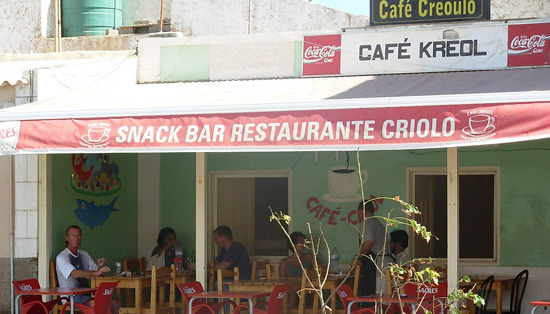
Have you heard of Creole languages?
Creole languages are not just languages used in specific regions; rather, they can be seen as a collection of similar languages based on "how they were created."
In simple terms, Creole is a language that formed when people who could not communicate with each other lived together for a long time, mixing various elements into a stable form.
Delving deeper reveals a somewhat sad background involving colonial history, the slave trade, and migrant labor.
Creole did not just appear out of nowhere. Initially, when communication was difficult, a very simple language was needed for minimal interaction. This is known as a pidgin language. It has a limited vocabulary and simple grammar, focusing more on practical communication like "move this" or "bring that" rather than expressing everyday emotions.
The Caribbean is a key area where pidgin languages are used.
British, French, Spanish, and Dutch colonies mixed together, and enslaved Africans lived alongside Europeans. In this process, English-based, French-based, and Dutch-based pidgins emerged. Many of these later developed into Creole languages.
The West African coast is also a core area for pidgin languages. In regions like Nigeria, Ghana, and Sierra Leone, English-based pidgin spread widely due to trade between European merchants and locals. Today, Nigerian pidgin is influential, used in everyday conversation, broadcasting, and even song lyrics. Although it is not an official language, it functions almost like a regional lingua franca.
Southeast Asia and the Pacific region cannot be overlooked either. In places like Papua New Guinea, the Solomon Islands, and Vanuatu, English-based pidgins emerged, with Tok Pisin being a notable example. Originally starting as a pidgin, it has now evolved into a Creole language and gained official status. This region, with its many islands and diverse languages, would have found communication difficult without pidgin.
Southern China and East Asian port areas have also historically seen the emergence of pidgins. In the China Coast centered around Guangzhou, a Chinese pidgin English mixed with English and Chinese was used in the past. It was primarily used in trade, and while it has nearly disappeared now, it remains a notable example in pidgin language studies.
However, a twist occurs when children begin to learn these pidgin languages as their mother tongue. Children do not simply use the basic language; they naturally create rules and expand their expressions. Thus, at some point, pidgin evolves into a complete language, and from then on, it is referred to as a Creole language.
What makes Creole languages interesting is that their words and grammar come from different origins. Words are usually borrowed from the language of the dominant country. This is why Creole languages in regions that were French colonies have a particularly high number of French words.
However, the sentence structure can be completely different from French. This is often due to the influence of African languages or indigenous languages in the grammatical sense. So, at first glance, one might think, "Oh, this looks like French," but after a few sentences, they may find themselves puzzled.
A prime example is Haitian Creole. While the vocabulary may heavily reflect French, its tense expressions and sentence structure take a completely different path. In Haiti, millions of people use this language as their mother tongue, and it is recognized as an official language. Other languages include Louisiana Creole, Martinique Creole, and Seychelles Creole. English-based Creoles are also significant, including Jamaican Patois, Barbadian Creole, and Sierra Leone's Krio.
Yet, many still refer to Creole languages as "broken English" or "sloppy French." This is a completely misguided perception. Creole is an independent language. It has grammar, rules, and can convey emotions and philosophy. In fact, there are many novels, poems, and songs written in Creole. Particularly in music, the connection between Creole languages and culture is profound. Genres like reggae, zouk, and sega illustrate how deeply intertwined Creole languages and culture are.
Another interesting point is that Creole languages are surprisingly practical. They often lack complex verb conjugations or gender distinctions, and tense is frequently expressed with separate words. Therefore, foreigners may find it surprisingly easy to understand the basic structure. At first, it may sound unfamiliar, but once they grasp the structure, they might nod in understanding, thinking, "Ah, that's how you say it."
In summary, Creole languages are not the result of a lack of language but rather a choice made by people to survive in extreme historical contexts.
They were born in places where different cultures and languages collided and have established themselves as languages that embody the identity of those societies over time. They should not be viewed lightly just because they are mixed; they are vivid examples of how languages are born and grow.







 lightyear |
 Moscow Kim |
 coloradoman |
 Montgomery Mom |
 GOGO SING |
 Shining Our Own World |

 California Kangaroo |
 Living Economy Information Blog |
 US Embassy |
  Korean Mom |
  My NYC |
  moo moo |
  Mr Oh |
  forevergee |
  festival |
  manchester |
  constant |
  Leapfrog Move |
  vibranto |
  Tora Tora |
  yellowbutter |
  Dolly |
  NYC saladbar |
  Finding Superfoods |
  song bang |
  vexomo |
  Indiana Jones |