

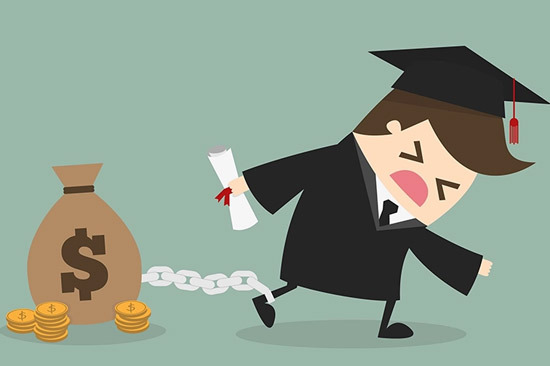
Anyone who has attended college in the U.S. knows the burden of student loans.
Graduating doesn't mean starting a career; it means starting with tens of thousands, sometimes hundreds of thousands, of dollars in debt. You can't help but wonder when you'll pay it all off.
However, starting July 1, the government announced it will reduce some federal student loan interest rates by up to 1 percentage point.
Currently, the total amount of federal student loans in the U.S. is a staggering $1.7 trillion.
This is significantly larger than the total credit card debt in the country. The more serious issue is that about 9 million people are in default, unable to make their payments on time.
In fact, many young people in the U.S. are delaying marriage or forgoing home purchases because of student loans.
Even with a paycheck, after paying for car loans, rent, and living expenses, the burden of student loan repayments remains significant.
The key point of the recent announcement from the Department of Education is that additional interest rate reductions will be offered to those who enroll in auto-pay.
The eligible loans are those taken out after July 2012. By enrolling in auto-pay, borrowers can lower their interest rates by up to 1 percentage point.
Those already using auto-pay were receiving a 0.25 percentage point discount, so the actual additional benefit is 0.75 percentage points.
For example, if someone has a loan with a current interest rate of 7% and meets the auto-pay conditions, their rate could effectively drop to 6%.
At first glance, a 1 percentage point reduction may not seem like much.
However, when considering the interest costs over several years on a principal of $50,000 or $100,000, the difference can be significant.
That said, not everyone will benefit.
The biggest condition is enrollment in auto-pay. Additionally, those currently in default must return to normal repayment procedures to qualify for the benefits.
According to the Department of Education, only about 40% of federal student loan borrowers currently use auto-pay.
This means that more than half of borrowers will need to take additional steps to receive benefits.
Reactions from experts to this policy announcement have been mixed.
Those with a positive view see it as a practical support measure that reduces interest burdens, even if slightly.
On the other hand, critics argue that it is far from a fundamental solution.
In reality, the core issue of student loans in the U.S. is not just the interest rates. The skyrocketing cost of college tuition itself is a much bigger problem.
In some private colleges, the combined annual tuition and living expenses can exceed $80,000. The structure that leads to graduates carrying hundreds of thousands of dollars in debt has not changed.
This measure is set to be temporarily implemented until the end of June 2028.
Additionally, the Trump administration is focusing more on increasing repayment participation and encouraging responsible repayment rather than the large-scale student loan forgiveness policies pursued during the Biden administration.
If reducing interest burdens is possible simply by enrolling in auto-pay, borrowers who meet this condition should definitely consider it.
While it remains to be seen how effective the interest rate cuts will be, it is likely to provide at least some relief to millions of borrowers.
 TONCOFFEE
 TalkVibe
 vibeworldbuilder1982




 Sugar Cream Door Bulletproof Noodles |
 Investment Campus Home Ownership |
 U.S. Retirement Pension Information |
 California Dreamer |

 Strawberry Candy Smoothie |
 Always Atlanta |
 SPACE SHIP |
 SAY YOU SAY ME |
 Bearded Strawberry Smoothie |
  Ohio Ohayoung Hello |
  parlon |
  Shoot Me |
  Michigan Enthusiast |
  festive |
  You Turn Me On |
  Supplemental Security Income (SSI) Information |
  Sams Market |
  ansdal |
  VVV 80 |
  BIODOCTOR NEWS |
  Gold Bar |
  Tamfa Fan |
  Jenny's Mom blog |
  Karina's Blog |
  Best Frozen Yogurt |
  Victory 1988 |
  Coding Elf |
  Infinite Style |
  Mr Cleveland |