

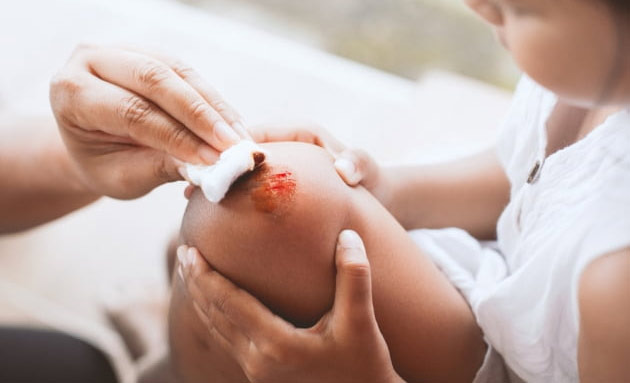
Recently, I was at the mall when a white child ran excitedly past me and suddenly fell to the ground.
His mother rushed over to help him up, but his knee was scraped and bleeding.
The child was crying, and the mother looked at his knee and said this.
"That is a pretty bad boo-boo."
Boo boo? What? A couple? At that moment, my brain's translator malfunctioned.
Here I was, someone who has been using English for over 15 years, completely thrown off by the word boo-boo.
I immediately looked it up on my phone.
Boo Boo — What is this?
It turns out that "boo boo" is a term used in the U.S. for young children, referring to a small injury or scrape, a form of baby talk.
It's used in a context like, "Oh dear, that must hurt a lot~" when a child falls and scrapes their knee.
So what the mother said was a gentle way of saying, "You got hurt pretty badly" at the child's level.
In fact, among American parents, this is a very basic expression. Phrases like "Let me kiss your boo boo" (I'll make it better) are used regularly.
But does this come up on the TOEFL? No, it doesn't. Is it in conversation textbooks? No, it isn't.
Can you hear it on CNN news? Of course not.
So no matter how much you study English in Korea, you won't encounter expressions like this.
English Words That Korean Men Especially Don't Know
This isn't the first time something like this has happened.
Living in the U.S., I've noticed that there are specific areas of English where Korean men are particularly weak.
These are "parenting English" and "emotional expression English."
While they can handle business English at work, they suddenly struggle to speak when trying to converse with other parents at the playground.
I'm sure I'm not the only one.
For example, there are expressions that American parents frequently use.
"Use your inside voice" — means to be quiet indoors. At first, you might think, "Use my inside voice?"
"Time out!" — means to put someone in a timeout. I only thought it was a sports term.
"Owie" — similar to boo boo, it's baby talk for something that hurts.
"Tummy" — a term used for stomach when talking to kids. "My tummy hurts" is a common expression.
"Potty" — means bathroom. When I first heard "I need to go potty," I thought they said party.
All these words are child-friendly expressions that are never taught in formal English education.
But in reality, this is the English you hear every day.
Especially in households with children, not knowing these expressions can make conversations with other American parents awkward.
Another Meaning of Boo Boo — Mistake
Interestingly, boo boo doesn't just mean an injury.
In everyday conversation, it is also used quite a bit to mean "mistake." Saying "I made a boo boo" is a light way of saying "I made a mistake." It's not a serious mistake, more like, "Oops, I slipped up a bit." Adults also use this expression casually. In the workplace, you might hear someone say, "Yeah, that was my boo boo" regarding a minor mistake.
And another thing. "Boo" is also a term of endearment for a partner or someone close.
So when someone says, "Hey boo," it has a similar nuance to "sweetheart."
Therefore, boo and boo boo are completely different contexts, so don't get confused.
If you say to your partner, "You're my boo boo," it would mean "You are my injury," which could lead to a romantic mishap.
So my thought is
Ultimately, English is about life, not test scores. Even if you score over 900 on the TOEIC or 100 on the TOEFL, you can still be thrown off by a single phrase from a mom at a U.S. mall.
That's the reality. The English you learn from books is different from the English you hear on the street.
Especially expressions like baby talk or slang can only be learned through real-life encounters.
I'm sure I'm not the only one who has been caught off guard by such unexpected expressions while living in the U.S.
 USAToday







 Korean Mom |
 novapixel |
 Peter Pan Pet |
 horse |
 Sunset Oregon |
 Fun Flex Life |
 Experiences Living in America |
 MacMorningBlog |
 laro90 |
  MEDBIO American Doctor Blog |
  SWAT TEAM BLK |
  DREAM BIG |
  frostbite |
  330 Forever My Love |
  El Dorado |
  dralix58 |
  Gorama Round |
  Skydiving |
  dreamport |
  Yellow Snowman |
  Toaster Pizza Magic Show |
  velvetnom |
  Anytime Journey |
  Mrs. Duluth |
  jaxter |
  Atlanta Mama |
  Baguette Blog |
  Tan Sol |