

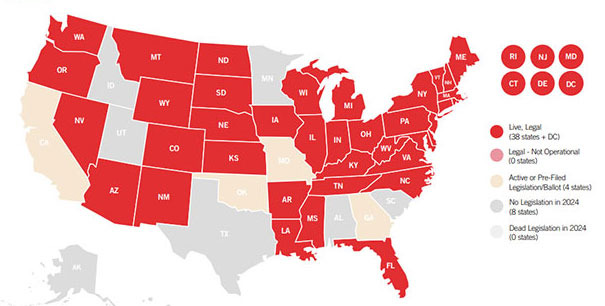
Recently, it has been reported that sports betting, which is easily accessible in the U.S., is leading to an increase in bankruptcies among young adults in their 20s and 30s.
Outwardly, many say, "I just want to enjoy the games more," but the reality is that just scrolling down a smartphone screen brings notifications for free bets, bonus credits, and today's picks. This has become a daily routine, especially for those in their 20s and 30s.
There are no official statistics comparing the bankruptcy rates of young people since sports betting was legalized by state. Instead, studies using data panels have emerged. These studies show that in states where online sports betting is allowed, average credit scores have declined, and indicators of excessive debt have worsened. There are analyses suggesting that the likelihood of bankruptcy applications could increase by 25-30% within 3-4 years after online access is opened.
While these figures are not exclusively targeting young people, there is a clear structure that makes young adults more vulnerable. The way the sports betting market affects them is quite simple. The illusion of winning big with a small amount of money is reinforced by parlay betting. The odds appear plausible, and the screens are flashy like games. The feeling that just one more bet could recover losses continues to be stimulated. In fact, survey results indicate that participation in online sports betting is more concentrated among young men, with warnings that signs of problems are rapidly increasing among men under 30.
Ultimately, bankruptcy is just the final outcome. Before that, warning signs such as credit card revolving, delinquencies, collection calls, and loan consolidations light up one by one. So, if you ask whether this is a problem-free industry, it becomes harder to say that it is.
The issue is not the sports themselves, but the accessibility that exacerbates the problem. It is open 24/7, lowers barriers to entry with bonuses, and is accompanied by advertising that becomes habitual. In fact, there seems to be a growing awareness of the negative social impacts of legalization within the U.S. recently.
At this point, we cannot ignore Texas and Hawaii. These two states are often cited as prime examples of those that do not allow sports betting, but to be precise, there are a few other states that have not yet implemented it. Nevertheless, Texas and Hawaii attract particular attention due to their significant symbolism.
Texas is not a state that refrains from action due to a lack of funds. Rather, we have the financial strength and political structure that allows us to adopt a non-urgent attitude toward this money. Traditionally, gambling regulations have been strict, and there is a deep-rooted conservative and religious opposition within the state legislature. Even recently, despite the industry's and sports teams' push, the atmosphere has remained difficult for passage through the legislature.
The basic agenda in Texas is closer to questioning whether it is necessary to bear social costs rather than expanding tax revenue. The calculation is that the moment the administration takes responsibility for addiction and debt issues just to collect a few more tax dollars, politics becomes more burdensome.
Hawaii has a different perspective. Hawaii has traditionally been very conservative about gambling, and due to the island's economic characteristics, it is sensitive to external capital and changes in industry structure. Recently, there was an attempt to legalize sports betting, but it fell through during the adjustment process between the House and Senate. There were significant disagreements regarding financial planning, such as tax rates and licensing fees. Hawaii's basic agenda is the stability of tourism and local communities. Once opened, advertising, platforms, and external businesses will flood in, and the structure will ultimately require the island to bear the costs of addiction that arise from it.
The conclusion is simple. Sports betting has already become an industry in many states and has deeply penetrated the lifestyles of young people. The problem is that the growth rate of the industry is much faster than that of safety measures. Bankruptcy statistics are merely the last stamp, and the signals of earlier stages are already visible everywhere. What is needed now is not a fight over whether it is legal or illegal, but a realistic debate about how far to limit designs such as online accessibility, advertising, bonus structures, and parlay inducements.
It may not be that Texas and Hawaii are particularly conservative, but perhaps they are the ones seeing the future costs of other states that have rushed ahead too quickly.







 El Dorado |
 lightyear |
 Moscow Kim |
 coloradoman |
 Montgomery Mom |
 garlic bread |
 Popular Song Exciting Song |
 Yo Lock Me Up |
 California Information News |
 DREAM BIG |
  frostbite |
  330 Forever My Love |
  dralix58 |
  Gorama Round |
  Skydiving |
  dreamport |
  Yellow Snowman |
  Toaster Pizza Magic Show |
  velvetnom |
  Anytime Journey |
  Mrs. Duluth |
  jaxter |
  Atlanta Mama |
  Baguette Blog |
  Tan Sol |
  US Embassy |
  Korean Mom |
  My NYC |