

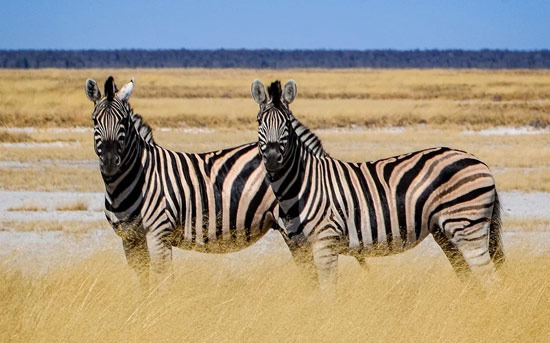
Yesterday, I watched a zebra video in a documentary suggested by the YouTube algorithm, and the world of this animal, which I only knew as a black-striped horse, was surprisingly interesting. Since I'm already in, I want to talk about the 'mystery of zebras'.
Zebras are widely distributed across the African savanna.
They inhabit a vast area stretching from the north of Sudan down to the Republic of South Africa, and while they are similar in size to the donkeys we commonly see, they are slightly larger.
Typically, they stand about 120 to 160 cm tall and weigh between 160 to 450 kg, and while it may not seem so in photos, they likely feel much larger and sturdier in person. Their average lifespan is about 25 years, but life in the wild is always an unscripted war, so most do not live to that age and end up being eaten by predators like lions or hyenas, or dying from drought or disease.
Interestingly, their social structure is matriarchal. Zebras form groups led by older females. The group consists of several females and a few males that join for breeding, and when the male leader changes, it sometimes kills the existing young and attempts to mate with the females again. It seems that the scenes we see in lion documentaries also exist in the zebra world, showing that nature is always harsh.
Predator stories cannot be overlooked. Adult zebras are primarily targeted by lions, while leopards, cheetahs, and African wild dogs mainly hunt the young. When a predator appears, most flee, but when cornered, they may retaliate with a kick. I've heard that a single misstep can lead to serious trouble, but against lions, that often doesn't work. At the water's edge, Nile crocodiles may also take the opportunity to strike, so a zebra's day is much closer to a battlefield than we might imagine. Behind the peaceful scenery of the savanna, there is always a tension of survival.
Despite this, these friends form quite a good cooperative relationship with other herbivores. When they are with giraffes, they can quickly detect danger thanks to the giraffe's high vantage point, and when with ostriches, the sharp-eyed ostrich spots danger first while zebras respond with their hearing and sense of smell. It's fascinating to see them complementing each other's lacking senses in a symbiotic manner.
Another interesting fact. Although their name includes 'horse', genetically they are closer to donkeys. Therefore, they can breed with horses and donkeys, and the hybrids born this way are called zebrids. A zebra plus a horse is called a zorse, a cross with a pony is a zonkey, and a cross with a donkey is called a zedonk. However, due to chromosomal issues, most are infertile.
At Jeonju Zoo in South Korea, there is an individual named 'Je-yeol', born from a zebra and a Jeju horse, and this friend was born not from artificial breeding but from a male horse jumping over the fence to mate with a zebra. It's more dramatic than a movie.
Their vocalizations are also different from horses. Initially, I was puzzled because they sound similar to barking dogs, but it turns out they use it as a kind of signal to alert each other or draw the group's attention. When such sounds are heard in the middle of the savanna, it's an emergency broadcast for zebras saying, "Hey, be careful!"
And one amazing fact. The amount of semen from a male can exceed 1 liter in gel form, depending on the situation. I thought that was quite something, haha.
The reproductive mechanisms of nature are endlessly fascinating. Considering the competition and survival surrounding reproduction, and the scenes that unfold in that process, the zebras we casually referred to as 'striped horses' are actually much more intense, instinctual, and fiercely living beings in the wild.
Their way of life seems both similar and dissimilar to ours. They form groups relying on each other, but when necessary, they become cold, sharpening their senses to survive day by day in nature. While they may appear calm and peaceful in photos, the tension of the wild and the laws of nature are etched into their stripes. Compared to our lives in the city, there are points of strange empathy, such as surviving in competition, forming groups, and sometimes having to endure coldness.
It's a day to see zebras again. Not just beautiful striped animals, but as a life fiercely breathing under the African sun, I felt that zebras looked different that day. Isn't learning little by little the fun of writing a blog?







 Weekend Movie Blog |
 Beauty, Health, Lifestyle Blog |
 coloradoman |
 Superman Cat Blog |
 novapixel |
  Tonky |
  viroma |
  cookie |
  Live and that's it |
  Alright Twain |
  eatontown blog |
  HAWAII Korean Church News |
  Amore |
  linex |
  Balancework |
  laro90 |
  MEDBIO American Doctor Blog |
  SWAT TEAM BLK |
  DREAM BIG |
  frostbite |
  330 Forever My Love |
  El Dorado |
  dralix58 |
  Gorama Round |
  Skydiving |