
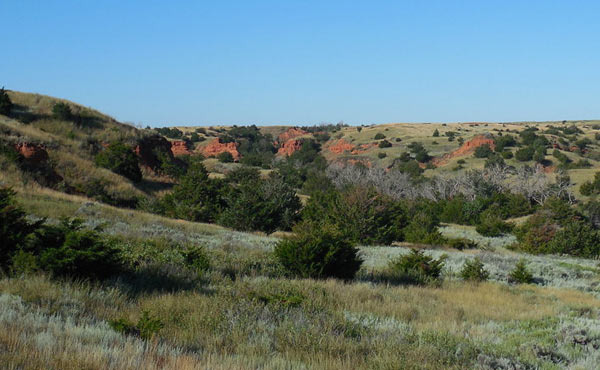
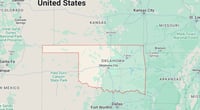
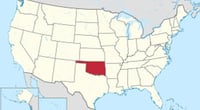
Oklahoma City is located right in the middle of the United States, in the heart of the Great Plains.
Therefore, the natural environment surrounding the city can truly be described as "the essence of the American Midwest." There are no seas or high mountain ranges, but instead, there are endless plains and skies. In summer, clouds bloom like cotton, and in winter, dry winds blow fiercely.
During the day, the sunlight shines strongly, and at sunset, a red glow envelops the city, marking the end of the day. The representative natural feature that runs through Oklahoma City is the Canadian River. This river flows southward, wrapping around the city as it crosses central Oklahoma after passing through the Texas Panhandle. There are well-developed parks and walking paths around the river, and especially the urban section called 'Oklahoma River' has been completely reborn with urban redevelopment.
It is not an exaggeration to say that Oklahoma City is the city of winds. Winds blow almost every day, and strong gusts often occur when the seasons change. This area is part of the 'Tornado Alley,' where tornadoes frequently occur in the United States. Therefore, in spring, the sky often darkens quickly, and fierce clouds gather. However, the residents are accustomed to such weather.
Each house has a basement shelter, and the weather service alert system is so well established that they accept it as part of daily life rather than thinking of it as dangerous. On the other hand, this wind is also utilized as an energy source. Oklahoma is one of the leading states in wind power generation in the United States, and white wind turbines line the outskirts of the city. When you drive out to the outskirts, you can see the landscape of windmills turning all the way to the horizon.
Just a little outside the city center, a completely different world emerges. To the north, the Great Plains stretch out, and to the south, lowland wetlands appear. In particular, the three artificial lakes, Lake Hefner, Lake Overholser, and Lake Stanley Draper, are beloved as places of relaxation for city dwellers. Lake Hefner is the representative lake of Oklahoma City, equipped with a yacht dock and bike paths, and the scene of dining at lakeside restaurants while watching the sunset is famous.
On weekends, it is crowded with families coming for picnics. In contrast, Lake Draper is more secluded and natural, attracting people who want to enjoy camping or fishing. In winter, you can also see migratory birds gracefully floating above the lake.
The reason Oklahoma City's natural environment is special lies in the way 'people and nature coexist.' As a large city, the road network is well developed, but green spaces remain throughout. The Myriad Botanical Gardens in the city center is a small jungle-like space in the urban area. Inside the glass dome conservatory, there are tropical plants and waterfalls, and outside, there are lawns, ponds, and seasonal flower beds.
In summer, concerts are held, and in winter, an ice rink is created, changing the atmosphere with the seasons. Additionally, Scissortail Park has recently become the most frequented place by citizens, connecting to the Oklahoma River. The park features ponds, walking paths, exercise spaces, and small performance stages, making it a natural gathering place for citizens.
The nature of Oklahoma City can often be extreme. In summer, temperatures can rise close to 40 degrees, and in winter, blizzards can sweep through. However, thanks to this weather, the sky's expressions are diverse, and the seasons are distinctly felt. When you see the sky changing colors multiple times a day, you realize that the charm of this city lies not in its glamorous skyline but in nature itself.






 daisypat |
 Chimhanbang Korea ACU |
 Trustworthy Faces |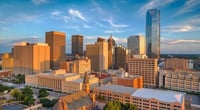
 US Regional Information Blog |
  US Embassy |
  Korean Mom |
  My NYC |
  moo moo |
  Mr Oh |
  forevergee |
  festival |
  manchester |
  constant |
  Leapfrog Move |
  vibranto |
  Tora Tora |
  yellowbutter |
  Dolly |
  NYC saladbar |
  Finding Superfoods |
  lightyear |
  song bang |
  vexomo |
  Indiana Jones |