
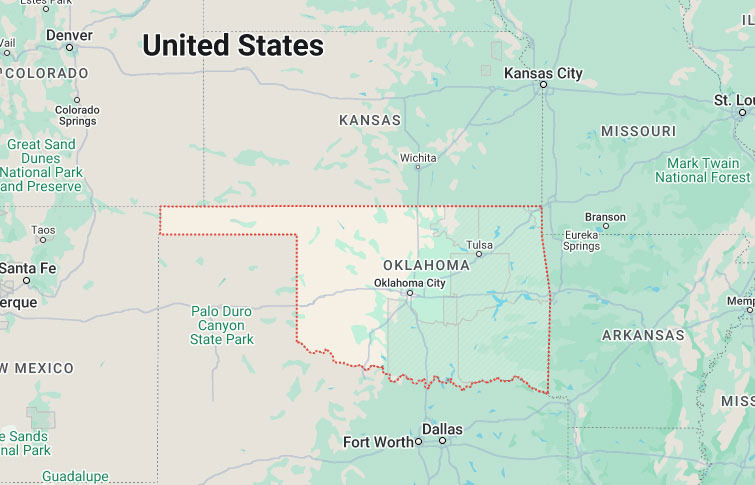
Oklahoma is located in the south-central United States and has several highways (freeways) that stretch in all directions. This is because several major interstate highways that cross the country pass through this region. Today, let's take a brief look at the major freeways in Oklahoma.
I-35 (Interstate 35)
One of the representative roads that runs north-south across the United States, starting near the Mexican border and extending through Texas, Oklahoma, Kansas, Iowa, and up to Minnesota. It serves as a gateway to enter or exit the city while passing through the state capital, Oklahoma City. To the south of Oklahoma City, it passes through college towns like Norman, and as you head north, it goes through suburban areas like Edmond, leading to the Kansas state border. It is very busy and has a significant amount of long-distance truck transportation.
I-40 (Interstate 40)
A long cross-country road connecting the southwestern and southeastern United States, linking Barstow, California, to Wilmington, North Carolina. It enters from the Texas Panhandle region to the west, runs through the center of Oklahoma City, and exits to the east into Arkansas. It can be said to be one of the busiest highways in the state. It serves as a hub connecting Oklahoma City, Shawnee, Henryetta, and Cherokee County.
I-44 (Interstate 44)
A highway that starts near St. Louis, Missouri, and runs through Oklahoma to the northeastern region of Texas. It enters from the east, passes through Tulsa, and has sections operated as a turnpike west of Tulsa (Oklahoma Turnpike System). After leaving Oklahoma City to the southwest, it passes through Lawton and leads to the Texas state border. The section from East Tulsa to downtown Tulsa and from Tulsa to Oklahoma City is famous for being a toll turnpike.
US-75 & US-69
Although they are not interstates, these federal highways (US Highways) play an important role in traversing and crossing Oklahoma.
US-75: It enters from northern Kansas, passes through Tulsa, and extends to southern Texas. It is a road frequently used for commuting in the suburban areas around Tulsa.
US-69: It connects the eastern part of Oklahoma north and south, linking the Texas border and counties, thus playing a significant role in logistics and commercial transportation.
Oklahoma Turnpike System
Oklahoma has several toll roads in the form of turnpikes, allowing drivers to choose faster routes. Notably, some sections of I-44 and the turnpikes directly connecting Tulsa and Oklahoma City (such as Creek Turnpike and Turner Turnpike) are representative examples.
Turner Turnpike: A major toll road connecting Tulsa and Oklahoma City.
Kilpatrick Turnpike: A road connecting the northwestern suburbs of Oklahoma City to I-35.
Cherokee Turnpike: A road extending from eastern Tulsa towards the eastern border of Oklahoma.
In summary, Oklahoma serves as a transportation hub where major arterial roads I-35, I-40, and I-44 intersect and pass through. Additionally, the turnpike system is well-established, making the driving environment quite convenient.
I-35 runs north-south, I-40 runs east-west, and I-44 stretches northeast-southwest, connecting major cities like Oklahoma City and Tulsa, playing a key role in logistics, tourism, and daily commuting. Although the turnpikes are toll roads, they are well-maintained and tend to have less traffic congestion, making them popular among drivers looking to save time.
If you plan to travel to or through Oklahoma, checking the locations, tolls, and major city information of these highways and turnpikes in advance will make your journey more convenient. Oklahoma has vast open plains with clear skies, making it a great area for enjoying the scenery while on a long drive.





 daisypat |
 Chimhanbang Korea ACU |
 Trustworthy Faces |
 US Regional Information Blog |
  Tonky |
  viroma |
  cookie |
  Live and that's it |
  Alright Twain |
  eatontown blog |
  HAWAII Korean Church News |
  Amore |
  linex |
  Balancework |
  laro90 |
  MEDBIO American Doctor Blog |
  SWAT TEAM BLK |
  DREAM BIG |
  frostbite |
  330 Forever My Love |
  El Dorado |
  dralix58 |
  Gorama Round |
  Skydiving |