

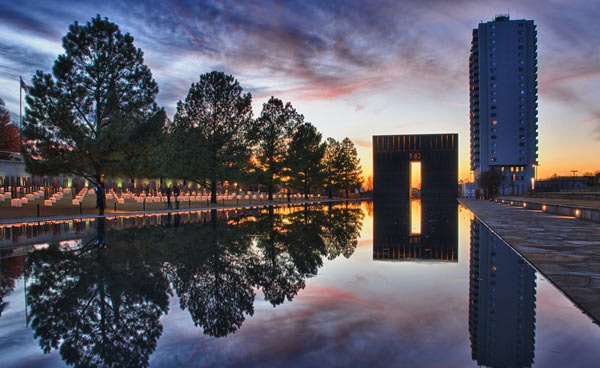
The Oklahoma City National Memorial is a space that captures one of the most painful moments in modern history.
On the morning of April 19, 1995, a massive explosion occurred in front of a federal building in Oklahoma City. This building was known as the 'Alfred P. Murrah Federal Building,' and at the time, many workers and children were at daycare, resulting in significant casualties.
The bomb was made from fertilizer explosives inside a modified truck, and at the moment of the explosion, the front of the building completely collapsed. There were 168 fatalities and over 600 injuries, marking it as the worst act of terrorism on U.S. soil.
The perpetrator was Timothy McVeigh, a Gulf War veteran, who committed this extreme act out of frustration over what he perceived as excessive government control over citizens. He was arrested shortly after the incident, sentenced to death, and executed in 2001.
In the aftermath of this event, the United States significantly heightened its awareness of domestic terrorism, and security systems and laws were greatly strengthened. Today, a 'National Memorial' stands in downtown Oklahoma City to honor the victims.
Among the victims were infants in daycare, as well as ordinary citizens such as workers, mail carriers, and security personnel. This incident was recorded as the most shocking domestic terrorism event in U.S. history until 9/11 and sent shockwaves not only through Oklahoma but around the world.
The reason for establishing the memorial was not just to remember the sorrow but to showcase 'recovery, forgiveness, and hope.' This site, created exactly five years after the incident on April 19, 2000, officially opened to the public.
Upon entering, the first thing that catches the eye is two massive iron doors. One side is engraved with '9:01,' and the other with '9:03.' These represent the times just before and after the explosion. The '9:02' in between symbolizes the moment the world stood still and the center of the memorial. Between the two doors is a reflecting pool with shallow water, where visitors can walk quietly and recall the memories of that day.
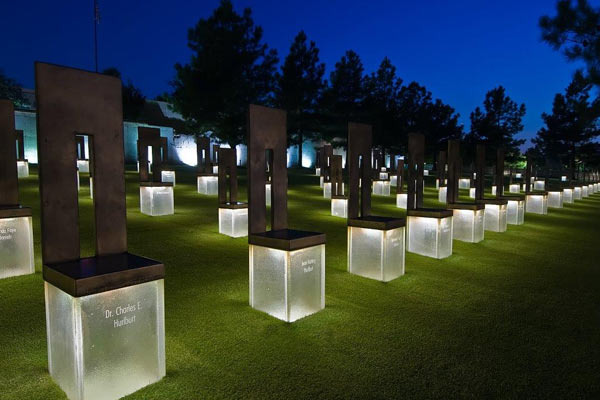
Passing the pond, a wide lawn with numerous chairs arranged in rows comes into view. A total of 168 empty chairs represent each victim. The chairs vary slightly in size, with smaller ones for child victims and larger ones for adults.
Each chair has a name engraved beneath it, and at night, lights illuminate them, casting a warm glow over the space. The front row features small chairs for children, and seeing them evokes a deep sense of sorrow.
Inside the memorial stands the 'Survivor Tree.' This American elm tree survived the flames and debris of the explosion and continues to grow green today. This tree symbolizes the resilience of the people of Oklahoma. Each time its leaves fall, the seeds are carried elsewhere to grow into new trees, conveying the message that "life continues even in darkness."
Inside the memorial, there is a museum. The exhibition hall vividly recreates the scene of that day, featuring actual police radio recordings, citizen rescue videos, debris, and personal belongings of the victims. It also includes records of the arrest and trial of the perpetrator, Timothy McVeigh.
However, the focus of the exhibition is not on the crime but on the people. It details how citizens helped each other that day and the sacrifices made by medical personnel, police, and firefighters. Visitors do not merely shed tears but feel the strength of humanity and the spirit of community.
This place is beautiful during the day, but it becomes even more special at night. The chairs on the lawn light up one by one, and their glow reflects in the shimmering pond. The memorial is not just a place to look back at the past but a testament to how humans can embrace each other even amidst great suffering.
The Oklahoma City National Memorial continues to attract hundreds of thousands of visitors each year. Not only the families of victims and survivors but also students and travelers from across the United States come here to learn about peace.
This quiet space reminds us that beyond the tragedies of the past, no matter what pain the world endures, humanity will ultimately rise again. Thus, the Oklahoma City National Memorial remains not just a place of remembrance but a symbol of courage and recovery.






 daisypat |
 Chimhanbang Korea ACU |
 Trustworthy Faces |
 US Regional Information Blog |
  Tonky |
  viroma |
  cookie |
  Live and that's it |
  Alright Twain |
  eatontown blog |
  HAWAII Korean Church News |
  Amore |
  linex |
  Balancework |
  laro90 |
  MEDBIO American Doctor Blog |
  SWAT TEAM BLK |
  DREAM BIG |
  frostbite |
  330 Forever My Love |
  El Dorado |
  dralix58 |
  Gorama Round |
  Skydiving |