
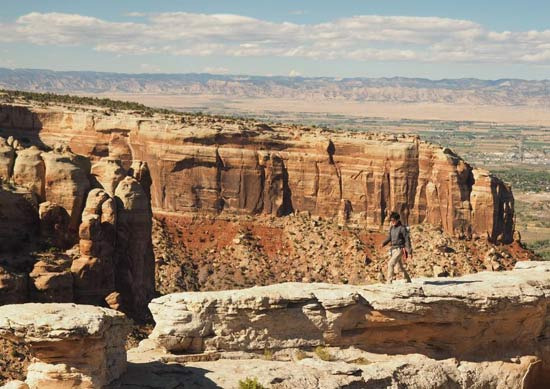
Living in Colorado makes you realize how long things have been buried underground.
I used to just pass by what I thought was just a rock, but knowing that it has taken an immense amount of time to become what it is today makes me feel a bit proud, as if I've learned something. Especially, Colorado is one of the regions in North America with very complex and diverse geology, featuring everything from layered sedimentary rocks to metamorphic rocks that formed the Rocky Mountains, and even traces of ancient seas. When I first heard, "Wow, this used to be underwater and is now a mountain?" I was truly surprised.
First, we have to talk about the Rocky Mountains. The beautiful mountain ranges we see while driving today were actually rocks that were deep underground millions of years ago, pushed up by tectonic movements. As the plates pushed and pulled, the crust folded and rose, creating such a magnificent mountain range. Just outside of Denver, you can see ancient metamorphic rocks like schist, and if you go to Estes Park or Rocky Mountain National Park, you can see rocks that are 1.7 billion years old right by the roadside. Thinking, "I'm stepping on a rock that's 1.7 billion years old?" makes even my knee pain feel a bit comforting.
The eastern plains of Colorado have a completely different atmosphere. There are many layers formed from sediments from when this area was once an ocean, and because of that, when you drive around Denver or Colorado Springs, the hills gently roll, and the soil appears in various shades of red and yellow. When I walk with my sisters, I often ask, "Why is the soil color like this?" and it all comes down to the iron content, minerals, and sedimentary environment. When I explain it in a somewhat expert tone, everyone is surprised, saying, "Wow, you can talk about that?"
Also, if you go to the Garden of the Gods, you'll see the red sandstone cliffs. At first glance, it looks like someone intentionally placed sculptures there, but in reality, they have been shaped by wind, rain, and ice over time. Originally, the sedimentary layers were stacked horizontally, but due to tectonic activity, they have tilted to stand almost vertically.
Heading west, the diversity increases. The Colorado Plateau is rich in dinosaur bones and ancient tree fossils, making you think, "This must have been like a jungle back in the day." Even the most mundane daily life feels suddenly awakened in such nature. There are Moai-like rocks, underground fossil forests, and even traces of volcanoes. Near Colorado Springs, there are remnants of a volcano that erupted long ago, and when I see those rocks, I think, "Wow, this place must have been erupting and chaotic back then."
In summary, Colorado is not just land; it's a museum of Earth's history. The north has metamorphic rocks, the central region has granite and the origin rocks of the Rocky Mountains, the east has sedimentary layers, the southwest has plateaus and canyons, and even dinosaurs and fossils can be found, so how could it not be amazing? When you think that even a handful of soil we walk on has stories spanning millions of years, even the dust that comes out while vacuuming feels somehow meaningful.
This is what I've felt living in this city. People often say Denver is a great place to go skiing and only talk about ski resorts, but if you understand the underlying geology, Colorado is truly a 'paradise for geology enthusiasts.'






 moo moo |
 ultron78 |
 garlic bread |
 Sugar Cream Door Bulletproof Noodles |
 urbanmint |
 Questions about firearms while living in America |

 forever young |
 Famous Attractions in the United States |
 Colorado Lee |
  round1 |
  Way to easy |
  musicque |
  road98 |
  Churros Train Conductor |
  gleeful |
  Burbank Lee |
  Olivia's Blog |
  Bushing Around Life |
  Active |
  Cherokee Rose |
  Kor. Master |
  Holey Moley |
  Conflite Teacher |
  Hodong Prince Over Flex |
  Mist inn |
  citrus pop |
  Onion Ring |
  phoenixia |
  viewtop |