

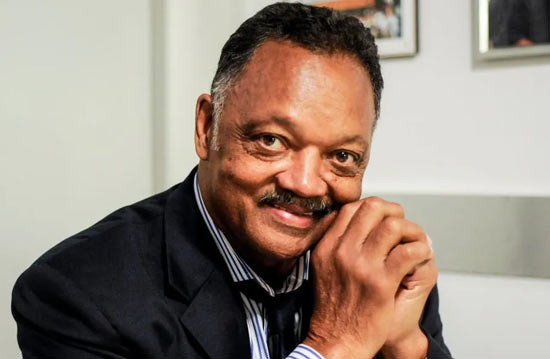
He reportedly died at the age of 84 after his health deteriorated due to Parkinson's disease.
Jesse Jackson. For the MZ generation, it might be a question of "Who is that?" But without this man, there would be no Obama.
Jackson's beginnings are a classic underdog story. He was born in a poor Black neighborhood and entered college on a football scholarship.
At first glance, it seems like a movie, but after experiencing racism on his team, he abruptly ended his athletic career.
Most people would lose their mental fortitude at this point. But he redirected his path to seminary, where he met Martin Luther King Jr.
And in 1968, he was right next to King when he was assassinated. He stood at the center of history.
After King's death, the civil rights movement faced a crossroads. "Will we continue to fight in the streets, or will we enter the system?"
Jackson chose the latter. He transformed the product of protests into a business model of political and economic pressure.
He organized corporate boycotts, economic pressure, and voter mobilization, even creating an organization called the Rainbow Coalition.
And this strategy worked. Since the 1970s, the Black middle class has noticeably increased, and the influence of Black politicians within the Democratic Party began to grow. Figures like John Lewis and Andrew Young entered politics largely due to Jackson's influence.
The most impactful moments for the public were the Democratic primaries in 1984 and 1988. Jackson garnered national support as a Black candidate. Although he did not win, this was significant because it demonstrated that "a Black presidential candidate can receive votes nationwide."
If this data hadn't existed, Obama's election 20 years later would have been much more difficult. Obama succeeded on the infrastructure that Jackson laid down.
Honestly, Jackson's methods had their limitations.
Boycotts and economic pressure were effective in the short term, but they did not resolve structural inequality. As of 2026, the Black poverty rate remains high, and educational disparities persist.
Moreover, the framework of "change through political pressure" that Jackson created can be seen as a precursor to today's cancel culture.
Of course, Jackson's era and today's Twitter lynchings are different in nature, but if you trace the DNA, there are connections.
The way the BLM movement unfolds differently from Jackson's generation seems to be a reaction to these limitations.
Above all, there are things lost by fully committing to institutional politics. Once you enter the system, you have to follow its rules.
This led to compromises with the Democratic Party, and the pure activist energy was diluted.
This is a dilemma that any organization faces as it scales up.
If Jesse Jackson had not existed, the landscape of American politics would be completely different today.
He was the person who translated the anger of the streets into the language of the system. He turned protests into votes and slogans into policies.
The reason the news is so loud right now is that it's not just one person who has left; it's the closing of an era.







 Moscow Kim |
 coloradoman |
 Montgomery Mom |
 GOGO SING |
 Hajiwon Blog Hair Salon |
 Your Curiosity Resolved |

 Jean Claude Bundang Blog |
 Successful Manager Kim's Team |
 meloncat |
  novapixel |
  mortrix |
  Esther 1983 |
  fortbliss |
  My Two Way |
  toastyfox |
  FLORIDA Acus |
  tracker |
  TONTON COFFEE |
  sunrise |
  ultron78 |
  uplifted |
  Folding Instructions |
  same same life |
  USA Hyundai Kia |
  morvex37 |
  BOL SA RAM |
  TOUCHE NEWS |