


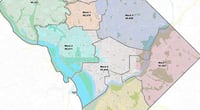
Washington, DC, home to federal and international organizations, has been evaluated as a housing market that is relatively less sensitive to economic fluctuations. However, there are clear differences in conditions across neighborhoods.
The Georgetown area is a high-end zone where listings often exceed $1.3 million, while Capitol Hill sees transactions typically between $900,000 and $1 million, and the NoMa and H Street areas appear to be trading in the range of $650,000 to $750,000.
Recent market observations indicate that NoMa and H Street are experiencing gradual price increases due to ongoing redevelopment, whereas areas like Georgetown, which already have high price points, are seeing a decrease in transaction volume and are remaining stable.
From an investment perspective, areas to watch include NoMa and Anacostia. With metro expansion and commercial redevelopment occurring simultaneously, accessibility and living infrastructure are improving, and the relatively low entry prices seem to be attracting a steady influx of young professionals.
In terms of rental yield, Anacostia and NoMa are relatively favorable. Calculating the rental levels against sales prices shows some cases yielding total returns around 4% annually, while Georgetown tends to have lower yields in the low 2% range due to its high sales prices.
However, changes in federal workforce policies or budget-related issues are consistently mentioned as risks that could impact the local economy. Areas undergoing redevelopment may also see temporary fluctuations in rental demand during construction periods.
For Korean households, the following points are worth considering:
- If considering employment with government agencies or international organizations, NoMa or Capitol Hill, which offer good accessibility, may be viable options.
- If prioritizing investment returns, it may be worthwhile to look at relatively undervalued areas like Anacostia.
- It is important to continuously monitor the impact of federal policy changes on the local economy.
Washington, DC, shows different growth stages across neighborhoods based on the stable economic foundation of the federal government, making the choice of area important for specific purposes.
 ShutUpSlump
 ImmigrantLife






 garlic bread |
 Sugar Cream Door Bulletproof Noodles |
 urbanmint |
 |
| 
 Premium Gas Camp |
 Washington Monument |
 heartbreaker |
 Eldorado 88 |
 Lemon EV Car |
 Washington Denzel DJ |
  novapixel |
  mortrix |
  ollege Mom |
  Esther 1983 |
  Arizona AZ Cowboy |
  fortbliss |
  Moscow Kim |
  My Two Way |
  toastyfox |
  FLORIDA Acus |
  tracker |
  TONTON COFFEE |
  sunrise |
  ultron78 |
  uplifted |
  Folding Instructions |
  same same life |
  USA Hyundai Kia |
  morvex37 |
  BOL SA RAM |