

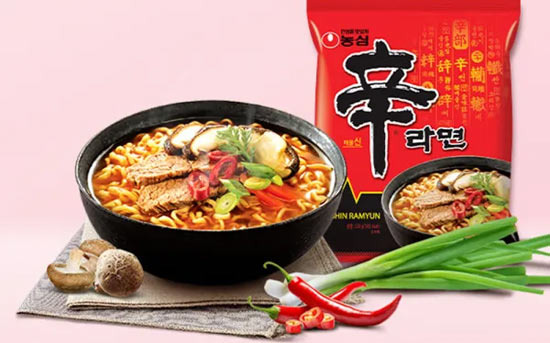
On a cold winter night in New York, with snowflakes falling, I naturally reach for a bag of Shin Ramyeon when I feel a bit hungry.
Although the flavor seems to have changed a few times, Shin Ramyeon still brings back many memories for me behind its spicy broth.
In fact, while spicy instant noodles are common now, there were none until the mid-1980s in Korea.
Back then, the standard was a light and savory chicken broth like Nissin's Chicken Ramen from Japan or Samyang Ramen from our country.
Shin Ramyeon, which emerged at that time, was a kind of adventure that targeted a niche market that was genuinely passionate about spicy flavors rather than following the mainstream.
Of course, there were spicy noodles like Yukgaejang, but Shin Ramyeon was the first to push the spicy flavor to the extent of using the character for 'spicy' (辛).
Interestingly, the background of this spicy flavor capturing the public's taste was influenced by the peculiar atmosphere of the times.
With the Asian Games and Olympics approaching, there was a nationwide sentiment to "show foreigners Korea's bold flavors."
As the trend of spiciness began to sweep through Korean cuisine, Shin Ramyeon literally exploded in popularity.
Moreover, while Samyang was faltering due to the Uji crisis, Shin Ramyeon completely took over the market, and since then, it seems that the idea that 'ramen must be spicy to be delicious' has been etched in the minds of Koreans like a tattoo.
However, these days when I buy Shin Ramyeon at a grocery store in New York and cook it, I sometimes find that it doesn't taste quite the same as before, which makes me tilt my head in confusion.
It used to be a premium line that represented Nongshim's pride, but now it feels a bit ambiguous in its position due to the many new products that have emerged.
It seems that comments about the soup quantity being reduced or the broth not being as rich as before are not unfounded, which is a bit bittersweet.
In fact, it seems that Korean snack bars have started switching to Jin Ramyeon, or that Shin Ramyeon Black is being evaluated as closer to the original taste, indicating that I'm not the only one noticing this change.
Still, I prepare Shin Ramyeon again on this cold night in New York.
Even while grumbling that the taste has changed and it's not as good as before, Shin Ramyeon remains my favorite ramen.
Here are five special tips for making Shin Ramyeon delicious:
Use slightly less water than the recommended amount.
Add a spoonful of beef fat while boiling.
Add only half of the seasoning when it starts to boil, and add the rest when the noodles are loosened. It changes the broth's flavor.
Be generous with the green onions. Add the white part first and the green part at the end.
Right before turning off the heat, drop the egg in without stirring. Just leave it as is.







 Moscow Kim |
 Seattle - Emerald City |
 self-evaluation |
 Sandiego Auntie |
 Karina's Blog |
 Whisper |
 MintO |
 nova nova |
 TwinBee |
 Living in the Eastern United States |
  manchester |
  constant |
  Leapfrog Move |
  vibranto |
  Tora Tora |
  yellowbutter |
  Dolly |
  US Embassy |
  NYC saladbar |
  Finding Superfoods |
  lightyear |
  song bang |
  vexomo |
  Indiana Jones |
  meloncat |
  novapixel |
  mortrix |
  Esther 1983 |
  fortbliss |