
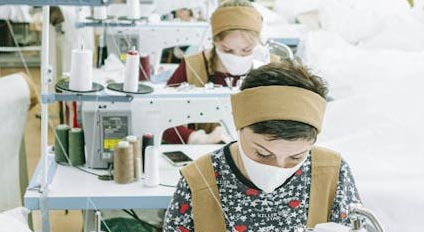
The decline in sales at the LA Downtown Fashion District's garment market has become serious in recent years due to various factors. Once considered the center of fashion wholesale in the United States, it is now facing issues such as declining sales, increasing vacancy rates, and business closures due to various economic and social changes.
In the past, it was common for numerous retail stores, including Korean wholesalers, to come directly to the garment market to pick up goods. However, as online platforms like Amazon, SHEIN, and Alibaba have grown, the need for direct visits has decreased. Retailers can purchase goods online at lower prices, weakening the competitiveness of the LA wholesale market. Additionally, the increasing homelessness issue in the LA area is also affecting the garment market. Especially since it is adjacent to Skid Row, safety concerns have become more pronounced. Business owners and buyers are hesitant to visit due to safety issues, leading to a vicious cycle of declining offline sales.As rental prices in the fashion district continue to rise, it has become difficult for small businesses to survive. Especially after the COVID-19 pandemic, with rents not normalizing and increases in taxes, labor costs, and logistics costs, many businesses are closing or transitioning online. In the past, there was a lot of production in the U.S., but now the reliance on overseas production in countries like China, Vietnam, and Bangladesh has increased, weakening the competitiveness of local factories and wholesalers. Since clothing made in LA is less price-competitive, buyers are increasingly turning their attention overseas.
The decline in sales in the fashion district is leading to an increase in vacancy rates, creating an overall stagnant atmosphere. However, some industry experts believe that the fashion district needs to shift from being solely wholesale-focused to embracing creative design, brand development, and small-scale custom production.
With the demand for small-batch production, handmade, and eco-friendly fashion increasing, some designers are attempting to differentiate themselves by utilizing direct production in LA. As the LA city government continues to push for downtown redevelopment, there is potential for revitalization in the fashion district with an increase in residential population and new commercial space development. Additionally, while more businesses are transitioning to online-based operations using platforms like Instagram, TikTok, and Shopify, the development of online sales channels for small and medium-sized businesses is not very active.
As the number of Korean wholesalers in the garment market decreases, the demand for factoring (receivables-backed loans) is also plummeting. In the past, many Korean clothing companies and fabric suppliers used factoring to secure business funds, but now the market itself is shrinking, significantly impacting the factoring industry. In particular, the demand for factoring began to decline in 2015, and the pace accelerated during the COVID-19 pandemic, according to news reports.
"We see the decline in factoring demand at the garment market as an opportunity rather than a crisis. We are expanding our factoring business to companies in various industries such as real estate, healthcare, construction, logistics, and delivery." A representative from a factoring company mentioned that factoring can be utilized not only by clothing companies but also by various sectors, and they are looking for new opportunities in line with changing market trends.
Ultimately, it seems that the garment market may find it difficult to regain its former vitality. However, companies that prepare for change by turning crises into opportunities will likely survive or find new opportunities.
The future of the Korean economy in LA has now become a world where adaptation and innovation are key. ㅋ







 Beauty, Health, Lifestyle Blog |

 coloradoman |
 Weekend Movie Blog |
 Victory 1988 |
 Superman Cat Blog |
  silverpath |
  Komet Park |
  reliable |
  vexo90 |
  As Always Today |
  veltar87 |
  United States National Administrative Organization Stories |
  springwaltz |
  dense |
  Tiger Milk Foam Research Institute |
  Oreore Mushroom |
  optimistic |
  Good Good |
  berion88 |
  bravo777 |
  skyblue |
  Project Tomorrow |
  apricotla |
  Soy Angelino |
  nati8 |