

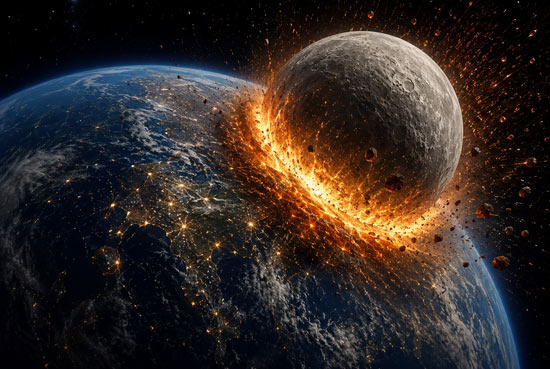
However, humanity still does not fully understand where this massive celestial body came from and what history it has gone through to become what it is today.
The most widely accepted theory of the moon's formation is the 'Giant Impact Hypothesis.' About 4.5 billion years ago, a Mars-sized body collided with the newly formed primordial Earth, and the massive amounts of rock and dust that were ejected into space coalesced to form the moon.
Today, most astronomers support this theory, but the events that occurred after the moon was formed remain a mystery.
Recently, researchers analyzed a lunar meteorite, NWA 12593, found in Northwest Africa.
This meteorite is believed to be a rock that was originally on the moon's surface, which was ejected into space after undergoing several collisions before landing on Earth. Scientists discovered traces of three major impacts within this small meteorite, with the oldest impact occurring about 3.5 billion years ago.
This timing is interesting because it is connected to the history of life on Earth.
The oldest known traces of life are also estimated to be around 3.5 billion years old.
In other words, primitive life was emerging on Earth while massive asteroid collisions were occurring on the moon.
The researchers calculated the timing of the impacts using radiometric dating techniques. Notably, the presence of cubic zirconia found in the meteorite provided crucial evidence. This material can only form at extremely high temperatures, indicating that the impacts generated enough energy to melt the moon's surface.
Even more astonishing is that similar-scale impact traces have been found on Earth and the large asteroid Vesta at the same time.
Finding records of impacts from the same period on three different celestial bodies is a very rare occurrence. This suggests that the 'Late Heavy Bombardment,' during which asteroids and comets heavily bombarded the planets in the early solar system, may have lasted longer than previously thought.
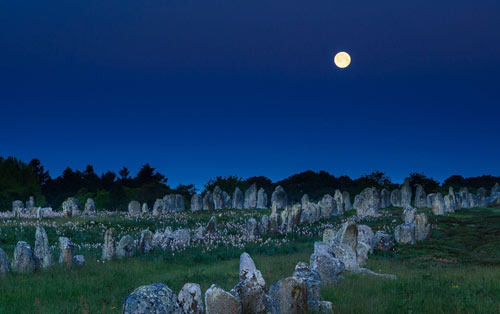
However, humanity has regarded the moon as special long before we understood these facts.
For prehistoric people, the moon was not just a simple celestial body. The sun was too bright to observe easily, but the moon changed shape every day, naturally capturing people's attention.
Archaeologists speculate that the 29 to 30 grooves carved into bones and stone fragments found in Paleolithic sites in Europe, dating back about 30,000 years, may have recorded the moon's cycles.
Since the advent of agriculture about 10,000 years ago, the importance of the moon has only increased. People used the moon's changes to predict seasons and determine planting and harvesting times. It is no coincidence that the English word "calendar" evolved from the concept of the moon's cycles.
Comparing the passage of time is astonishing.- Formation of the solar system: about 4.6 billion years ago
- Formation of the moon: about 4.5 billion years ago
- The large impact discovered this time: about 3.5 billion years ago
- First traces of life: about 3.5 billion years ago
- Appearance of dinosaurs: about 230 million years ago
- First human ancestors: about 7 million years ago
- Appearance of modern humans: about 300,000 years ago
- Beginning of written records: about 5,000 years ago
In other words, the events discussed in this research occurred long before humans began recording history, in a time that is almost unimaginable.
The reason the moon is important lies here. On Earth, most traces of the past have been erased due to wind, rain, volcanic activity, and tectonic movements.
However, the moon has almost no atmosphere or water, and geological activity is limited, allowing the traces of impacts from billions of years ago to be preserved. This is why scientists refer to the moon as the 'history book of the solar system.'
Ultimately, this discovery does not completely reveal the origin of the moon. However, it is undoubtedly an important piece of the puzzle that shows what upheavals the moon has experienced since its formation. If humanity builds bases on the moon again and brings back more rock samples, we may gain a more accurate understanding of not only the moon's history but also the origins of life on Earth and the early environment of the solar system.
For thousands of years, humanity has looked at the moon, creating myths, calendars, and imagining the future. And now, science is beginning to read the 4.5 billion years of history hidden within the moon little by little. Perhaps at the end of lunar research, we will be one step closer to answering humanity's greatest question: "Where do we come from?"
 OmingOming
 StarlitCloud
 Nova Nova







 Study Abroad Life Know-How Tips |
 USA Business News |
 Hawaiian Soft Tofu HASOON |
 Shintongbangtong Shin Naerin James Park |
 California Dreamer |
 U.S. Weather Bureau News |
  Only Dentalbay |
 Shining Our Own World |
 Tarzan's Joyful Imagination |
 Time is GOLD |
  Wenda |
  Roman Pan |
  Nuchuhan Exploration BLOG |
  Who's watching? |
  Strawberry Pancake Warrior |
  What can make money? |
  Egg Steamed Pot |
  New Jersey News Local Stories |
  My Love DS |
  Leapfrog Move |
  US Regional Information Local News |
  Finding Superfoods |
  COLO COLO |
  morixa |
  nero kim |
  USA Hyundai Kia |
  OC Real Estate Business Information |
  My Town My Way Blog |
  Splendid Mission |