

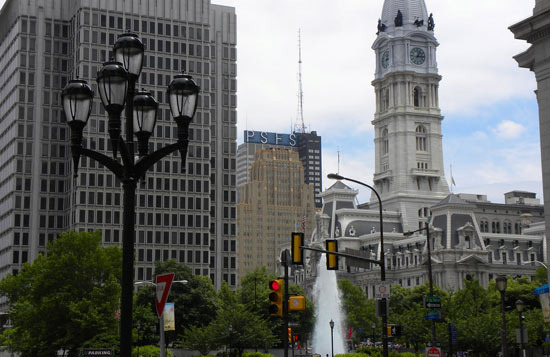
Many people are curious whether the Korean population in Philadelphia is increasing or decreasing, but in fact, the more noticeable change is the "shift in Korean residential areas." In other words, it is more accurate to say that they are spreading from the city to the suburbs.
In the 1970s and 1980s, Koreans began to gather in urban areas of North Philadelphia, such as Olney and Logan. Restaurants, laundries, grocery stores, and Korean markets emerged in these areas, and churches offering services in Korean appeared, naturally creating a "little Korea" atmosphere. At that time, most of the first-generation immigrants operated businesses and lived primarily in the urban commercial districts, so the concentrated Korean areas were almost exclusively here.
However, as time passed, Korean families became economically stable and began to consider their children's education and living environment, leading them to move away from the city. Now, the areas chosen by Koreans have increasingly included suburban regions such as Cheltenham, Abington, Plymouth Meeting, Blue Bell, and North Wales.
There has also been an increase in families moving to southern Pennsylvania, which is close to New Jersey, and there are quite a few people who work in Philadelphia but live in Delaware or New Jersey. The reasons for this migration are clear: good school districts, spacious homes, and safe environments. The educational interests of Korean families remain high, and suburban public schools often receive more stable evaluations than those in the city.
Additionally, the normalization of a car-dependent lifestyle has played a significant role in reducing the necessity to stay in the city. In the past, one had to live in the city due to work and commercial areas, but now, Korean markets, churches, hospitals, and tutoring centers are evenly distributed in the suburbs, eliminating the reasons to be tied to the city.
Korean businesses are also adapting to these changes. In the past, the structure was centered around markets and restaurants in the city, but now, large markets, tutoring centers, beauty salons, dental offices, real estate, and Korean restaurants are spreading in suburban areas. In other words, "the commercial areas follow where Koreans live." As a result, the Korean community is shifting from a 'neighborhood' model concentrated in one place to a 'network community' spread across multiple regions.
While the Korean population in downtown Philadelphia has either decreased or stagnated, the Korean population in suburban areas has definitely increased. In terms of total numbers, it has neither significantly decreased nor exploded, but the key point is that the map of where "Koreans in Philadelphia" live is changing.
In the past, Koreans lived together in the city and operated stores, but now they live in spacious homes in the suburbs, commute by car, send their children to good schools in desirable districts, and visit suburban Korean markets and churches on weekends.
The Korean community in Philadelphia can be thought of as 'not shrinking, but expanding.'




 moo moo |
 ultron78 |
 garlic bread |
 Sugar Cream Door Bulletproof Noodles |
 urbanmint |
 sparkling |
 Nationally Certified Lightning Charcoal Review |
 Northeastern |
 Pennsylvania Information News |
 U.S. Weather Bureau News |
  round1 |
  Way to easy |
  musicque |
  road98 |
  Churros Train Conductor |
  gleeful |
  Burbank Lee |
  Olivia's Blog |
  Bushing Around Life |
  Active |
  Cherokee Rose |
  Kor. Master |
  Holey Moley |
  Conflite Teacher |
  Hodong Prince Over Flex |
  Mist inn |
  citrus pop |
  Onion Ring |
  phoenixia |
  viewtop |