

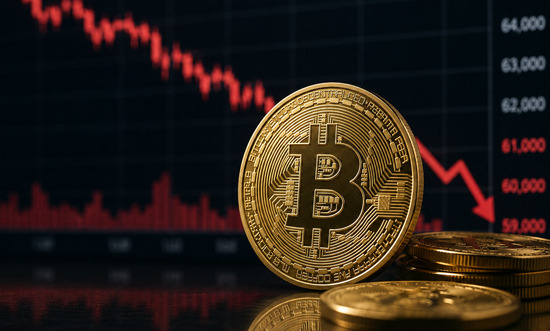
On June 24, 2026, Bitcoin's price fell below $60,000, increasing concerns among investors.
During the day, it dropped to around $59,000, creating the most anxious atmosphere of the year.
In fact, this decline is not just a Bitcoin issue; it is also due to significant corrections in AI-related tech stocks and semiconductor stocks, leading to a sell-off in risk assets overall.
Particularly noteworthy for investors is the sharp decline of major semiconductor companies, including NVIDIA.
This year, AI has been the strongest theme driving the market, but as the stock prices of the companies at its center begin to shake, investor sentiment is rapidly deteriorating.
When there is a movement to reduce risk in the stock market, one of the first assets to be affected is cryptocurrency, and it seems a similar trend is emerging this time as well.
The movement of institutional funds is also putting pressure on the market.
In the US Bitcoin spot ETF, it is reported that about $6.4 billion has flowed out in the past month.
Until early this year, the inflow of institutional funds through ETFs was a key driver of Bitcoin's rise, but now, outflows are acting as a factor pressuring the price.
A fact that individual investors often overlook is that Bitcoin is significantly influenced by the cash flow of large institutions. Therefore, the outflow of billions of dollars from ETFs like this carries more meaning than just simple price fluctuations.
Another variable is Strategy, known as the largest holder of Bitcoin.
This controversial company has been all-in with an aggressive Bitcoin buying strategy, leading to renewed concerns about leverage.
Experts are also warning of the possibility of further declines as the support level around $60,500 breaks down.
If the selling pressure continues, opinions suggest that levels below $50,000, even down to $46,000, could be on the table.
On the other hand, long-term investors view this decline as just another correction process.
Bitcoin has experienced several drops of over 30-50% in the past 15 years, but it has ultimately created new highs.
Thus, there are still voices suggesting that attention should be focused more on the expansion of institutional adoption and long-term demand rather than short-term price fluctuations.
Ultimately, it seems the current market has entered a phase where fear is stronger than greed.
As the AI boom and stock market rally take a breather, Bitcoin is also not escaping the impact.
The problem always arises with individual investors who jump in near the peak.Hearing stories of making money from those around them, they enter the market, but when faced with a sudden drop, it becomes psychologically difficult to hold on.
Like stocks, Bitcoin can move nearly 10% in a day, so the sense of fear is much greater.
The reason is that in investing, surviving is more important than greed.
In my opinion, whether Bitcoin can recover to the $64,000 mark again or enter a deeper correction phase is likely to be determined by the movements of the US stock market.
 UrbanGlow83







 mapsina |
 Mr. Largo |
 Victory 1988 |
 Infinite Style |
 novapixel |
 Archaic Kim |

 US Embassy |
 BMW700 Luxury |
 torvik |
  charger |
  holy cheese |
  Pleasant K |
  Rolling Joy Life |
  lidus |
  French Macarons |
  Central Intelligence Agency Deputy Director |
  ATL Power 1 |
  MP Forever |
  Soy Angelino |
  San Jose Pop |
  Pronunciation Yo |
  hamooo |
  Entip |
  Yavrix 92 |
  cherry cherry |
  Coastal city |
  There Are Such Things in the World |
  Mazinger Z Rocket Punch |