

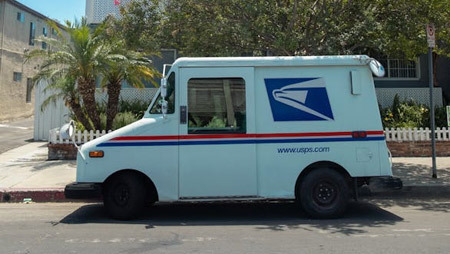
USPS, which provides postal services across the United States, is a government-owned postal service. The image of working at USPS was strong as a stable job with guaranteed pensions.
The USPS headquarters is located in Washington, D.C. Its symbolic color is blue, and the eagle is its emblem. It is almost exclusively responsible for mail delivery in the U.S., handling about 142 billion pieces of mail, packages, and various advertisements each year.
The origins of this organization date back to 1775. It started when Benjamin Franklin, a representative from Pennsylvania at the Second Continental Congress, proposed a postal system.
He even took on the role of the first Postmaster General. Later, in 1792, an official postal law was established, solidifying it as a national system. In a vast country like the United States, sending a single letter was not easy, so postal service was not just a convenience but a foundation of life.
Throughout the 19th and 20th centuries, mail became an integral part of daily life. Especially with the issuance of the first postage stamp in 1847, the postal culture we know today was formed. At that time, there were no phones or the internet, making it almost the only means of connecting people.
Then, in 1971, a significant change occurred. It transitioned from the previous 'Post Office Department' to an independent public corporation structure through the Postal Reorganization Act. Its name was also changed to the current USPS.
While USPS is not entirely a private company, it has a unique structure that requires it to generate its own revenue. However, the appointment authority for the Postmaster General and the Board of Governors still lies with the President.
Looking at USPS today, it certainly feels like a vast network connecting the entire country.
It has a 'universal service' obligation to provide services at the same rates not only in cities but also in rural and mountainous areas. While private delivery companies may reduce services if they are not profitable, USPS cannot do that. This is its most significant characteristic.
However, the current situation has changed significantly from the past. With emails and messaging becoming commonplace, the volume of letters has greatly decreased. Instead, the increase in online shopping has led to a rise in package deliveries. As a result, USPS is in the process of restructuring to focus more on deliveries.
The issue is finances. The burden of labor costs, such as pensions and health insurance, is quite substantial, leading to continuous deficits. This remains a challenging issue to resolve even today.
Looking ahead, USPS is still an indispensable institution in the U.S. because it provides a system that connects the entire country uniformly in a vast nation with significant regional disparities.
In the past, many Koreans preferred jobs at USPS due to the image of stable pensions and civil service. However, the situation has changed now. The workload is higher than expected, and especially with the surge in package deliveries, the physical demands have increased. Additionally, the labor intensity compared to the starting salary is high, and the promotion structure is limited. There is also a growing perception that salary competitiveness compared to private logistics companies is not as strong as before, leading to a shift in interest towards more flexible and profitable jobs.
 ThirstyJjang







 eatontown blog |
 Toaster Pizza Magic Show |
 US Embassy |
 fortbliss |
 Folding Instructions |
 Bald Eagle Brothers |
 Bacon King Blog |
 PETRO Vatican Shrine |
 Seattle - Emerald City |
 Real Estate Agent USA |
  Tonky |
  viroma |
  cookie |
  Live and that's it |
  Alright Twain |
  HAWAII Korean Church News |
  Amore |
  linex |
  Balancework |
  laro90 |
  MEDBIO American Doctor Blog |
  SWAT TEAM BLK |
  DREAM BIG |
  frostbite |
  330 Forever My Love |
  El Dorado |
  dralix58 |
  Gorama Round |
  Skydiving |