

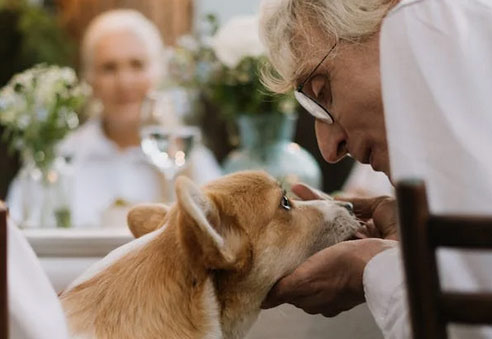
Life after retirement is definitely free. You're not rushed by a morning commute, and no one is telling you what to do.
However, once you step into that freedom, the days can become surprisingly quiet. The reasons to move around decrease, and opportunities to meet people noticeably diminish.
A common concern among many retirees is this static daily routine and social isolation.
At this point, a dog becomes not just a pet but the best partner to help recreate the rhythm of life.
The reasons why life with a dog after retirement is beneficial are more practical than you might think.
The first is that a regular routine is reestablished. The first thing to fall apart after retirement is often the daily rhythm. A dog doesn't allow for that gap. You have to get up in the morning to feed them, and you need to take them out for walks. Your day regains a schedule. Just knowing there's a being that relies entirely on you gives you a sense of purpose.
The second is exercise. You might have a gym membership but not go often, but when a dog is waiting at the front door, the story changes. Even if it seems short, walking twice a day is enough to maintain strength and cardiovascular health. It's not forced exercise; it naturally encourages you to move, which is less burdensome. Once you develop a walking habit, it improves not just your body but also the quality of your sleep.
The third is connection with others. It's natural for social relationships to decrease after retirement, but having a dog changes that. You naturally start conversations with people you meet on walks. Asking about the dog's name, age, and where they live leads to familiar faces. A dog becomes a bridge that reconnects retirees to their community.
The fourth is emotional stability. Even when you're home alone, having a dog means the space isn't empty. Their presence is comforting, even if they can't speak. The sight of them wagging their tail to greet you on an ordinary day can be surprisingly uplifting. As loneliness decreases, feelings of depression naturally lessen as well. This is more about experience than explanation.
The fifth is brain health. Caring for a dog isn't simple. You need to manage their food intake, monitor their condition, and observe changes in behavior. The process of learning new training methods and changing their environment keeps your mind engaged. It requires much more judgment and decision-making than a day spent doing nothing.
Of course, preparation is necessary. You need to choose a dog that fits the retiree's physical ability and lifestyle, and you should realistically plan for long-term care. But if you're prepared, a dog can become the warmest companion to fill your time after retirement.
Retirement is not an end but a transition. If you spend that transition time with a dog, the second act of your life can be much more vibrant and fulfilling than you might expect. I believe that a dog, a loyal animal to humans, adds meaning to your free time.





 neroyo |
 nivex85 |
 Old English |
 nixxon |
 LIZ Legal Information Blog |
 Tomato Health Club blog |

 Open Flex Mind |
  Bushing Around Life |
 Korean Mom |
  My NYC |
  moo moo |
  Mr Oh |
  forevergee |
  festival |
  manchester |
  constant |
  Leapfrog Move |
  vibranto |
  Tora Tora |
  yellowbutter |
  Dolly |
  US Embassy |
  NYC saladbar |
  Finding Superfoods |
  lightyear |
  song bang |
  vexomo |
  Indiana Jones |