

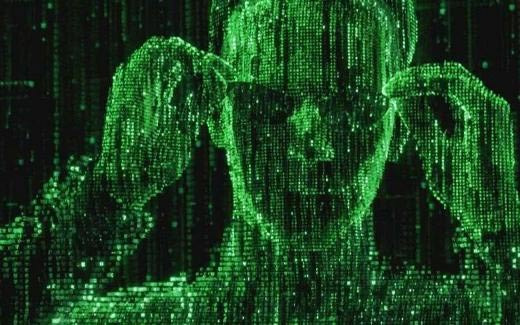
It is true that smartphone photos, YouTube videos, streaming MP3s, and even the voices heard during calls are all made up of numbers.
The simple binary information signals of 0s and 1s stack and combine to create the images and sounds we perceive as reality.
This can be explained technically, but it is not intuitively easy to understand.
Imagine trying to explain this concept to people just 100 years ago.
"Invisible numbers come together to show a person's face and even let you hear their voice?"
They would likely have perceived it as something close to magic or illusion.
At that time, the concept of transmitting information using electricity or radio waves was also considered highly advanced technology.
From that perspective, the digital environment we take for granted today is at a magical level by past standards.
So, what exactly constitutes the sensory experience we call "reality"?
Sight, hearing, taste, touch, and smell. All of these are converted into electrical signals through the body's sensory organs and then interpreted by the brain.
In other words, we do not experience reality "as it is"; rather, we are experiencing electrical patterns created by the brain.
Current research shows that just as digital technology converts the external world into numbers for reproduction, the human brain also converts external stimuli into electrical signals for internal reconstruction.
Thus, both digital and human sensory systems process information in structurally similar ways.
The only difference is that one is silicon-based and the other is a biological neural network.
The direction of future technology can be somewhat predicted.
Currently, we are indirectly reproducing sensations through devices like cameras, microphones, and speakers.
However, ultimately, there is a possibility that it will develop into a method of directly transmitting signals to the brain without these intermediary devices.
Initial forms of research are already underway. If this technology becomes sufficiently sophisticated, what might be possible?
Theoretically, visual information could be delivered directly to the brain's visual cortex without going through the eyes.
Descartes touched on this issue 300 years ago: "How can I prove that I am not dreaming right now?"
The Matrix packaged this concept into science fiction and dominated the box office, and philosophers are still writing papers on it today.
Elon Musk's Neuralink has made "moving a mouse with your thoughts" a reality.
The next step is for computers to directly input sensations into the brain. The moment that becomes possible, the boundary between reality and the virtual will blur significantly.
This is where the world of the technological singularity opens up.
We currently say we experience "virtual reality" through VR devices, but that still only deceives the eyes and ears.
In contrast, if signals are delivered directly to the brain, a person could reach a state where it is difficult to distinguish between what is virtual and what is real.
This is because the very basis of how humans perceive reality is through brain signals.
Here, the question arises: "How do we distinguish whether an experience is real or not?"
If the brain feels sensations of the same intensity, does it matter whether they come from the external world or are artificially generated? This question leads to fundamental issues about human existence, not just technical problems.
Of course, it will take considerable time for such technology to become a reality.
The structure of the brain is extremely complex, and accurately interpreting and reproducing signals at the level of individual neurons is still in its early stages.
Additionally, there are significant ethical issues. Technology that can directly control sensations and emotions could deeply impact human free will and identity.
Nevertheless, we already possess technology that converts reality into numbers and then reconstructs those numbers into sensations.
And the human brain, after all, operates as a system of electrical signals. The intersection of these two elements is likely to be the core of future technology.
The digital technology we use today is at a level that would be considered magical by past standards.
And in 100 years, the experiences we now call "reality" may enter a realm that is technically reproducible.
From this perspective, the future could represent a transition to an era where "experiences themselves can be designed."
And that change will raise questions that are far more fundamental than we might think.






 Anova US Beauty Information |
 anchor |
 Korea Tiger News |
 Alpha and Omega World |
 Florida King |
 Baguette Blog |
 eatontown blog |
 Story Bank |

 Running and Running Watchman |
  Granola |
  joyfull yang |
  Olivia's Blog |
  Living in America and Writing Essays |
  Piano Teacher Blog |
  bearcup |
  explorer |
  dictionary |
  Mr Bull Jung |
  radiant |
  Georgia 88 |
  Great TOWN NEWS |
  Open Flex Mind |
  Hartford Blog |
  unified |
  Generation X |
  ringwinds |
  American Food Information & Calories |
  Hawaii Maui Kahului |
  calvorn |