

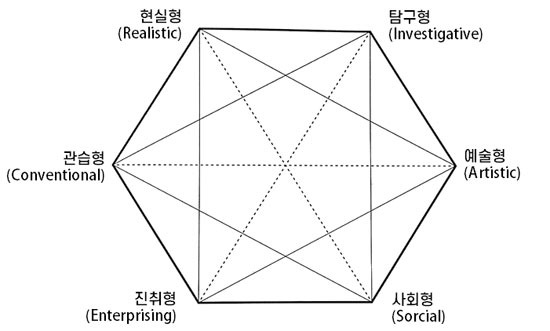
There is a phrase that often appears in popular psychology articles or discussions about organizational capabilities. It is the hexagon model, which at first seems like a strange way to map out a person's life like an engineering blueprint, but upon closer reading, it oddly aligns with reality.
Especially after turning forty and going through a full cycle of life, there are many moments where you think, "Ah, so that's why it was like that." When starting with similar abilities, the reason some people succeed while others remain stagnant is not solely due to a lack of effort, and this framework helps clarify that.
The hexagon model ultimately divides life into six elements: ability, effort, environment, luck, personality, and choice. When these six vertices are balanced, the shape stands upright, and if one side is distorted, the overall shape becomes skewed. It may sound trivial, but it surprisingly aligns well with reality. Everything from work life, business, relationships, money, marriage, to health operates within this structure.
First is ability. This includes innate qualities like intelligence, talent, physical strength, and dexterity. This cannot be denied, even if one wants to. Everyone starts from different starting lines. However, having high ability does not automatically mean life will go smoothly; that is absolutely not the case. It is true that in certain fields, starting with a favorable ticket is advantageous.
Next is effort. This is the area I reflect on the most. Even if you are recognized for your abilities, if you do not consistently push forward, one side of the hexagon simply shrinks. Conversely, those with average abilities who persistently hold on will eventually thicken that side. Looking around at people my age, this is where most differences emerge.
Environment cannot be ignored. Family circumstances, educational background, the people you meet, the neighborhood you live in, and even the atmosphere of your workplace all constitute the environment. With the same abilities and efforts, the results can vary completely depending on the environment one is placed in. This is undeniable once you experience it.
Luck is something everyone tries to ignore, but it is actually the biggest factor. Who you meet and when, what industry you enter at what time, and a chance opportunity can split your life into two. After turning forty, everyone tends to acknowledge this. It becomes clear how cruel it is to label someone without luck as simply lazy.
Personality is more formidable than one might think. Perseverance, responsibility, emotional control, and resilience in crises. These create the sustainability of effort, attract people, and ultimately change the environment. The saying that personality is the root of life did not come about for no reason.
Finally, there is choice. Career, spouse, friends, business, investment. These are the handles of life. With similar abilities and environments, a single choice made at a crossroads can lead to completely different lives. This becomes more apparent as one ages.
The good thing about this model is that it prevents life from being judged solely by effort. Some may have sufficient ability and effort but are blocked by their environment, while others may sail smoothly due to favorable circumstances and luck. And if one vertex becomes too weak, the whole structure eventually shakes. Everything is interconnected.
Therefore, when observing others' lives through this framework, it becomes a bit easier on the heart. You start to see that someone was lucky, that their environment was different, or that their choices made a difference, rather than falling into the thought that you are the only one lacking. Conversely, when looking at my own life, I begin to see where I can make changes. It is not just about squeezing out effort; sometimes, it is necessary to change the environment or adjust choices.
Ultimately, the hexagon model is not a grading sheet for life but a control panel. Occasionally sketching out what shape my hexagon is in helps me see why I feel frustrated and where I am lacking. Once you understand this, life starts to feel a little less unfair, and you begin to see that there are still many areas where you can take action. I think it is not a bad idea to reflect on this model after turning forty.
 WhenISeeHer







 Korean Mom |
 novapixel |
 Peter Pan Pet |
 horse |
 Sunset Oregon |
 Pirate Ship Popcorn Maker |
 Total Beauty |
 California Information News |
 ROLDU WAY |
 OC Real Estate Business Information |
  US Embassy |
  My NYC |
  moo moo |
  Mr Oh |
  forevergee |
  festival |
  manchester |
  constant |
  Leapfrog Move |
  vibranto |
  Tora Tora |
  yellowbutter |
  Dolly |
  NYC saladbar |
  Finding Superfoods |
  lightyear |
  song bang |
  vexomo |
  Indiana Jones |