

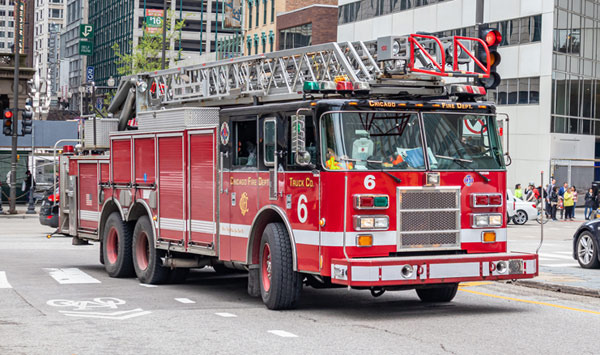
As I learned about the great fire in Chicago, I gradually discovered the special history and traditions of Chicago firefighters.
On the evening of October 8, 1871, a fire that started on O'Leary Street in the southwest of Chicago spread rapidly due to strong winds.
At that time, most buildings in Chicago were made of wood, and the streets were filled with dust and sawdust due to dry weather, which caused the flames to grow uncontrollably. With a lack of firefighting personnel and equipment, the firefighting efforts were helpless, and the fire swept across the city for two days, burning an area of about 3.3 square miles.
As a result, over 17,000 buildings were destroyed, more than 100,000 people lost their homes, and at least 300 people were recorded as dead.
The scale of the damage dealt a fatal blow to the economy of Chicago at the time, but this great fire paradoxically became a catalyst for the city's reconstruction and modernization. After the fire, building codes were significantly strengthened, the use of fire-resistant building materials became mandatory, and firefighting systems and equipment were modernized.
The Great Chicago Fire is remembered as a historic event that changed the face of the city and laid the foundation for the fire safety standards that continue to this day.
Since that great fire, the professionalism and strong unity of firefighters have emerged.
Chicago firefighters still commemorate the 'Great Fire Anniversary' every year with memorial services and parades for their fallen colleagues.
One of their traditions, known as 'Firehouse Open House,' involves opening the fire station doors wide to show equipment to citizens, allowing them to ride on fire trucks, and providing fire prevention education.
It's not just a simple event; it's a place to convey the message, "We are always by your side."
The welfare system is also very well established. The Chicago Fire Department operates health insurance, retirement pensions, and mental health counseling programs for firefighters and their families.
In particular, the 'Peer Support Program' for the prevention and treatment of post-traumatic stress disorder (PTSD) is quite famous. Since fire scenes can have a significant impact on both the body and the mind, sharing experiences and helping each other recover is really important.
However, no matter how well the system is set up, the risks that firefighters face cannot be avoided.
A common occupational disease among Chicago firefighters is chronic respiratory disease, as prolonged exposure to smoke, toxic gases, and fine dust can lead to conditions like asthma, chronic bronchitis, and COPD. Additionally, repeated exposure to high heat increases the risk of cardiovascular disease.
In fact, statistics show that heart disease is the leading cause of death among firefighters.
Injuries are also quite varied. During rescue operations, fractures, dislocations, burns, and muscle injuries are common, and many firefighters get cut by debris from collapsed buildings or sharp metal.
In large cities like Chicago, slipping on icy roads during winter is also common. These injuries often do not end with simple treatment, as long-lasting aftereffects can make it difficult to return to work.
Yet, the reason Chicago firefighters continue this work is clear.
A strong sense of mission to "protect each other" and pride in protecting citizens.
Inside the fire station, there is a phrase that says, "Everyone Goes Home"...
It is a promise to protect each other so that all colleagues can return home safely.
I sometimes see fire trucks racing with sirens blaring in downtown Chicago.
In that moment, knowing how dangerous the place they are heading to is, I always send my gratitude and support in my heart.






 lightyear |
 Moscow Kim |
 coloradoman |
 Montgomery Mom |
 GOGO SING |
 Khan Film Blog Production |
 Illinois Mom |
 Rice Shop Uncle BLOG |
 Enjoyable American Life Diary |
 allstar realty |
  US Embassy |
  Korean Mom |
  My NYC |
  moo moo |
  Mr Oh |
  forevergee |
  festival |
  manchester |
  constant |
  Leapfrog Move |
  vibranto |
  Tora Tora |
  yellowbutter |
  Dolly |
  NYC saladbar |
  Finding Superfoods |
  song bang |
  vexomo |
  Indiana Jones |