

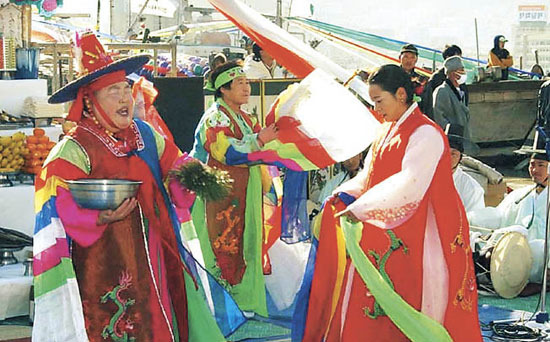
The world seems to operate on reason and logic, but beneath it lies a vast, inexplicable anxiety that drives everything, and I believe that in Korean society, this anxiety is most starkly connected to shamanism.
To be honest, we often mock shamans as superstitions, yet we ultimately acknowledge their existence. We point fingers at superstitions, but when life hits rock bottom, many people find themselves desperately seeking out fortune tellers.
There have been many self-proclaimed rationalists around me. A friend who graduated from a prestigious university and worked at a large corporation once said, "I don't even believe in MBTI," but after being scammed by a business partner last year and facing family troubles, he ended up at a well-known fortune teller's place.
While we usually worship science and logic, when our lives are completely shaken, we instinctively seek answers to the question, 'Why is this happening to me?' Hospitals can heal our bodies, and courts can settle disputes, but they cannot explain the reasons for our grievances. That void is filled by shamans. A simple phrase like, "It's not your fault; your luck just ran out," becomes the last lifeline for our shattered self-esteem.
At the core of Korean shamanism lies the emotion of Han. War, poverty, discrimination, and unjust deaths have accumulated, creating a need for a space to express that anger and sorrow, which is why shamanistic rituals have survived. These rituals serve as collective psychological counseling and a massive emotional outlet. Shamans channel the voices of spirits to release pent-up frustrations, allowing those who have lived suppressed to finally share their stories. Viewed from today's perspective, it resembles a highly sophisticated form of group therapy.
Shamanism holds a unique significance in the history of Korean women. When a woman who has lived namelessly under patriarchy receives a divine calling, she becomes 'the spokesperson for the gods' and the most feared figure in the village. Shamanism is a pathway for oppressed women to reclaim their voices and a gap in the social structure for survival.
The reason Korean shamanism has survived until now is that it is extremely pragmatic. It addresses issues like credit card bills, exams, business, and children rather than focusing on heaven or the afterlife. In a society filled with uncertainty about tomorrow, people seek immediate solutions rather than philosophical musings about the future. This practicality is the lifeblood of shamanism.
The most peculiar aspect is the concept of divine illness. People come to believe that if they do not become shamans in the face of inexplicable illnesses and near-collapse, their lives will fall apart, ultimately becoming vessels for the divine. It is more akin to a survival system than a religious calling. It is a structure where one enters the path of listening to others' suffering to stop their own pain.
Even more interesting is the Republic of Korea in the age of AI. While technology has reached its peak, shamanism has become even more vibrant. Politicians, conglomerates, entertainers, and job seekers all turn to fortune-telling and tarot. Technology has advanced, but human anxiety has not. In fact, as the world becomes more complex, people seek certainties that data cannot provide.
Thus, the reason there are so many shamans in Korea is not because we are peculiar, but because we have lived through so many hardships. This relationship, which we can't help but acknowledge even while criticizing, may very well reflect the way this country has continued to function until now.



 novapixel |
 Peter Pan Pet |
 horse |
 Sunset Oregon |
 daisypat |
 Weekend Movie Blog |
 Beauty, Health, Lifestyle Blog |
 coloradoman |
 Superman Cat Blog |
 Awesome Blog |
  forevergee |
  festival |
  manchester |
  constant |
  Leapfrog Move |
  vibranto |
  Tora Tora |
  yellowbutter |
  Dolly |
  US Embassy |
  NYC saladbar |
  Finding Superfoods |
  lightyear |
  song bang |
  vexomo |
  Indiana Jones |
  meloncat |
  mortrix |
  Esther 1983 |