

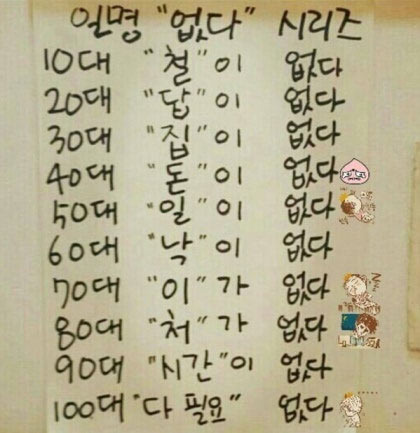
One day, I received the 'Lack Series' via KakaoTalk from an acquaintance, and while it was amusing, it also contained some thought-provoking content.
From teenagers to those in their 100s, the writings list what is lacking at each age, and to me, they seemed to encapsulate serious truths about life.
When we look closely at our daily lives, they often feel like a tragicomedy filled with boredom and unhappiness.
Failures in exams, mistakes at work, misunderstandings between people, and frustrating economic realities due to poor investments or decisions.
In those moments, it feels as if the world is collapsing, but after a little time passes, those scenes become laughable like a comedy.
The reason why what seemed tearful up close becomes an episode of life from a distance is that, ultimately, humans are imperfect and flawed beings.
Our struggles themselves are a drama, and the process of falling and getting back up becomes a comedy.
Thus, life is both a tragedy and a comedy.
In our teenage years, there is no "sense." Indeed, it is impossible to have a sense.
Lacking experience, our perspective on the world is shallow, and it is natural to only know what we know. This is a time when family and school education are crucial. The stories and values shared by parents and teachers lay the foundation for life. I too, in my teenage years, followed friends without thinking and caused trouble, worrying my parents. Looking back now, it was natural to lack sense at that time, but a proper environment was essential.
In our twenties, there are no "answers."
After graduating from school and stepping into society, it is difficult to find a clear path. Even while preparing for employment, doubts arise about whether this is the right path, and in relationships, one cannot be sure if this person is a lifelong partner. There are many desires and big dreams, but one keeps hitting the wall of reality and loses the answers. Moreover, there is no money. Even if one earns a living through part-time jobs or receives their first paycheck, it quickly disappears into living expenses. Nevertheless, the process of searching for answers and experiencing trial and error in one's twenties becomes the most valuable asset.
I was the same. There were many things I wanted to do, and the world seemed vast, but the reality was worrying about tuition, food costs, and drinking expenses. I still remember the time before graduating from college when three friends and I boasted about changing the world while chatting all night over a few bottles of soju and canned food. I also recall the memory of being so broke that I could only give a small gift to my girlfriend from my part-time job, and we both teared up with joy. Perhaps that time, when there were no answers and no money, was the most mentally free period of my life.
In our thirties, there is no "home."
When one gets married and has children, the biggest topic becomes housing. The path from renting to buying a house is always long and arduous. I too struggled with housing issues throughout my thirties. Friends compared themselves, saying some bought apartments while others took on debt. But looking back, a home is not just a simple wall and roof; it holds greater meaning as a sanctuary for the family. One can be happy without a home, but it is true that having one adds a bit more peace of mind.
In our forties, there is no "money."
Raising children, paying off home loans, and taking care of parents leaves no room for saving money. I also started a business but was always plagued by financial difficulties. The forties are the busiest and most responsible years of life. However, the lack of money at this time symbolizes not just a low bank balance but the weight of life itself. Still, if one perseveres, there will come a time when there is a little more leeway.
In our fifties, there is no "work."
It seems like the prime age to work in society, but reality is different. Younger colleagues are rising up, and the world is changing rapidly. I too managed to continue my business in my early fifties, but eventually began to contemplate retirement. 'No work' may not just mean lacking a job, but could signify a time to step back from social roles. It was a signal that I needed to shift the focus of my life from work to family and myself.
In our sixties, there is no "joy."
After retirement, I found myself waking up with nothing to do. At first, freedom felt good, but soon a sense of emptiness set in. Therefore, one must find hobbies and travel. Without joy, one can age quickly. Small pleasures like gatherings with friends, light exercise, and reading become the vitality of the later stages of life. I am still learning what true joy is only after retirement.
In our seventies, there is no "teeth."
Here, 'teeth' refers to dental health. When teeth weaken, even eating delicious food is not enjoyable. In fact, half of health management can be said to be dental care. No matter how diligently one brushes when young, as one ages, gums inevitably weaken and teeth fall out. Not only that, but joints and organs that seemed fine often start to fail. Therefore, the truth is that to enjoy life, one must maintain health throughout their life.
In our eighties, there is no "partner."
Many find themselves alone after their spouse passes away. Of course, women tend to live longer than men, so most women outlive their husbands. However, losing a partner is an unimaginably painful sorrow. Yet, on the other hand, it is also a time to learn to enjoy solitude. Friends around also begin to pass away one by one, and ultimately, it is oneself who fills that void.
In our nineties, there is no "time."
Each day comes as a gift. There are many things one wants to do, but the body does not cooperate, and one realizes that time is not long. Thus, in the nineties, one comes to cherish time even more. Small conversations and short walks become precious moments.
In our hundreds, there is "nothing needed."
By then, one may have completely freed themselves from the obsessions of life. Money, home, work, joy, ultimately, all of it passes.
To reach a state where one can say that simply breathing today is enough, that is the wisdom of being in one's hundreds.
Reflecting on my life while looking at this 'Lack Series'.
The times of being senseless, the times of lacking money, the times of worrying about housing have all passed. And now, I stand in my sixties, where it is written that 'there is no joy.'
But I am writing this to find new joy.
Ultimately, 'lack' is not just a deficiency but perhaps indicates the tasks we must fill during that time.
When I reach that thought, this short phrase leaves me with another lesson about life.





 Weekend Movie Blog |
 Beauty, Health, Lifestyle Blog |
 coloradoman |
 Superman Cat Blog |
 novapixel |
  US Embassy |
  Korean Mom |
  My NYC |
  moo moo |
  Mr Oh |
  forevergee |
  festival |
  manchester |
  constant |
  Leapfrog Move |
  vibranto |
  Tora Tora |
  yellowbutter |
  Dolly |
  NYC saladbar |
  Finding Superfoods |
  lightyear |
  song bang |
  vexomo |
  Indiana Jones |